

January should feel like momentum. New routines. Fresh starts. People finally dealing with the thing they ignored all fall.
And yet… the front desk is waiting for a wave that never fully hits.
If that’s you, here’s the uncomfortable truth: you might be earning the demand, but losing it at the door.
Not your physical door. Your digital one.
Because in 2026, “I’ll just Google it” is the first appointment request. If your clinic isn’t visible locally, if your site takes forever to load, or if Google can’t clearly understand what you offer, patients don’t stop, they keep scrolling.
Let’s break down the expectation vs reality, and the three most common reasons clinics miss January.
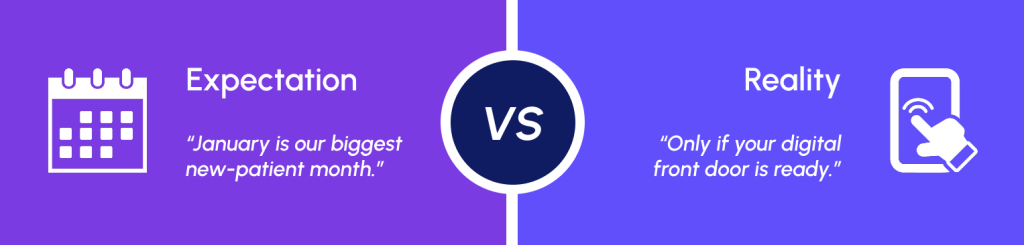
January can bring a lift, but it’s not a magic spell. You don’t automatically get the rush just because the calendar flipped.
What is predictable: when demand rises, competition rises too. Other clinics lean in with better local visibility, stronger reviews, faster sites, and cleaner technical signals.
So even if you should be busy, patients can still walk right past you online.
1) Local visibility: “We exist” isn’t the same as “We show up”
Most clinics think local visibility means “our name is on Google.”
That’s baseline. Not a strategy.
Google has been very clear that local results are mainly based on three things: relevance, distance, and popularity.
So if you’re not showing up in the map pack or local results, it’s usually because Google can’t confidently match you to the search… or other clinics look like a safer bet.
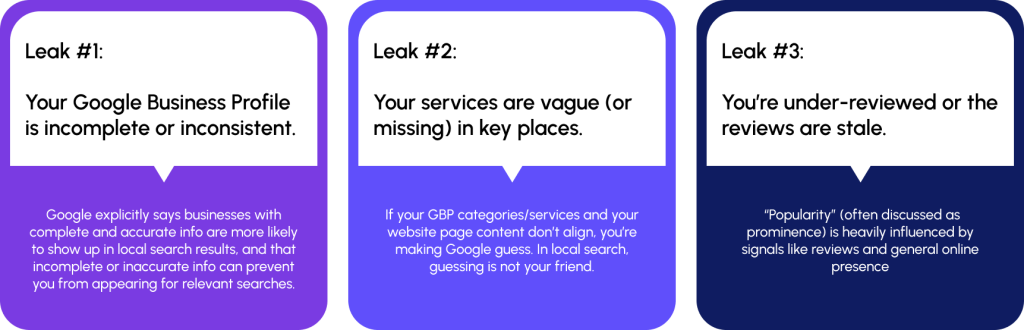
The most common local visibility leaks
Quick win checklist (local visibility)
- Fully complete your Google Business Profile (services, hours, photos, description, appointment link).
- Make sure your NAP (name, address, phone) matches everywhere.
- Build service pages that match what people actually search (not just “Services”).
- Create a review system that runs weekly, not “when we remember.”
2) Speed: You can’t convert patients who never wait for your site
This is the silent killer of the January rush.
People click. The site lags. They bounce. You never even get rejected. You get ignored.
Google’s research found 53% of mobile visitors leave a page that takes longer than 3 seconds to load.
In other words: you might be paying for ads, posting content, and building pages… just to deliver patients into a loading screen.
“But our site loads fine for me.”
Of course it does. You’re probably on good Wi-Fi, on a familiar device, maybe with cached files.
Google’s Core Web Vitals are based on real-world user experience metrics, not best-case scenarios.
And Google recommends hitting strong Core Web Vitals because it aligns with what their ranking systems try to reward.
The Core Web Vitals targets to care about
Google spells out these goals:
- LCP (loading): aim for 2.5 seconds or less Google for Developers
- INP (responsiveness): aim for under 200 ms Google for Developers
- CLS (visual stability): aim for under 0.1 Google for Developers
How to check performance (without guessing)
- Use Google Search Console’s Core Web Vitals report, which shows performance based on real-world usage data (field data).
- Understand that this field data is tied to how real Chrome users experience the web, reflected in datasets like the Chrome UX Report (CrUX).
Quick win checklist (speed)
- Compress and properly size images (this is the #1 clinic website weight problem).
- Reduce heavy sliders/animations that slow down LCP.
- Clean up plugins and scripts you’re not using.
- Improve mobile layouts that shift around (CLS), especially on service pages and appointment pages.
3) Structured data: If Google can’t “read” your clinic, you look smaller than you are
Structured data is one of the most misunderstood advantages in local SEO.
It’s not about making your site pretty. It’s about making your site legible to search engines.
Google explains it plainly: structured data gives explicit clues about the meaning of a page, helping Google understand it. It can also enable more engaging search results (“rich results”).
For local clinics, this matters because your website isn’t just a brochure anymore. It’s your digital proof.
LocalBusiness structured data (the bare minimum most clinics skip)
Google’s Local Business structured data documentation notes that it can help you tell Google about details like business hours, departments, and more.
That’s the difference between:
- “This is a website that mentions chiropractic.”
- “This is a local chiropractic clinic with these hours, in this city, offering these services.”
Here’s a simplified example (your developer can tailor it):
<script type="application/ld+json">
{
"@context": "https://schema.org",
"@type": "Chiropractic",
"name": "Your Clinic Name",
"url": "https://yourclinic.com",
"telephone": "+1-000-000-0000",
"address": {
"@type": "PostalAddress",
"streetAddress": "123 Main St",
"addressLocality": "Your City",
"addressRegion": "ON",
"postalCode": "A1A 1A1",
"addressCountry": "CA"
},
"openingHours": "Mo,Tu,We,Th,Fr 09:00-17:00"
}
</script>
Important note: structured data is not a magic ranking button. It’s a clarity tool. But in competitive local markets, clarity compounds.
Quick win checklist (structured data)
- Add LocalBusiness (and relevant subtypes) sitewide.
- Mark up reviews only if you’re following Google’s structured data policies.
- Validate with Google’s Rich Results testing and Search Console error reporting (so you’re not flying blind).
The January Ready “Digital Front Door” Checklist (steal this)
If you want the January rush to feel real, aim for these minimums:
Local visibility
- Google Business Profile fully complete and accurate
- Consistent NAP everywhere
- Service pages that match real searches (location + service intent)
- Active review flow (new reviews in the last 30 days)
Site speed
- Mobile loads fast enough that users do not bounce (3 seconds is the danger zone)
- Core Web Vitals trending “good” for key pages (home, service pages, contact, booking)
Structured data
- LocalBusiness schema in place
- Clean, policy-compliant markup
- No errors reported in Search Console
Final thought: January doesn’t reward hope. It rewards readiness.
If you’re thinking, “We should be busier,” you’re probably right.
But “should” doesn’t convert.
Your clinic can earn the traffic, and still lose the patient… if the digital front door sticks, lags, or looks unclear.
If you want to make sure you’re actually set up to capture the January rush, book a discovery meeting with Spinealytics. We’ll take a look at what’s happening and map the fastest path to more booked appointments.
Because January isn’t long. And patients don’t wait around.