

Nothing spikes a clinic owner’s heart rate quite like a fresh 1-star review.
You’re having a solid week. The schedule is full. The team is humming. Then you open Google and see a one-liner that feels like it was written by a cartoon villain at 2:00 a.m.:
“Awful experience. Never again.”
No context. No details. Just chaos.
Here’s the reality: one bad review won’t sink a great clinic. But how you respond can shape how future patients interpret your reputation. The goal isn’t to “win” the comment section. The goal is to protect trust, reduce future risk, and turn a messy moment into a stronger system.
Reputation management is a core pillar of online growth. It sits right beside your website conversion, local visibility, and content strategy. If you’re building toward predictable demand (instead of relying on January spikes), reviews become even more important because they influence conversion in every month—not just the busy ones. If you’ve read our breakdown on seasonal spikes and predictable growth, you already know why consistency matters:
https://spinealytics.co/from-seasonal-spikes-to-predictable-demand-stop-relying-on-january/
Now let’s walk through what to do after a 1-star review, step-by-step, with templates and a simple internal SOP your team can actually follow.
First: what not to do (because it will make it worse)
Before we talk about the “right” response, let’s talk about the instincts that tank trust.
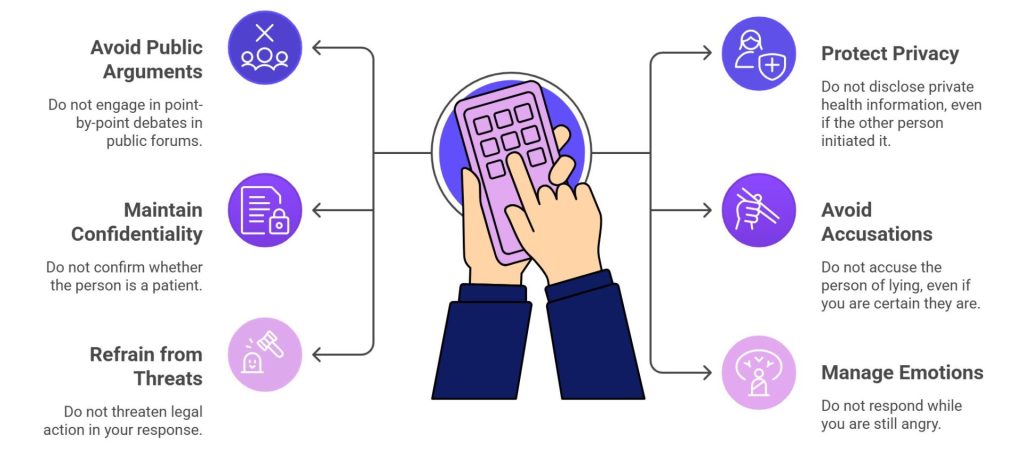
Do not:
- Argue point-by-point in public.
- Mention private health details (even if they started it).
- Confirm the person is a patient.
- Accuse them of lying, even if you’re sure they are.
- Threaten legal action in the reply.
- Respond while you’re still angry.
Google reviews aren’t a courtroom. They’re a trust signal. People reading your reply aren’t looking for a takedown, they’re looking for clues about how your clinic behaves under pressure.
If your reply feels defensive, sarcastic, or overly emotional, the review becomes two bad experiences instead of one.
Step 1: Pause, screenshot, and verify
Your first move is not public. It’s operational.
- Screenshot the review and log the date/time, reviewer name, and star rating.
- Check your records for any match to the name (and note: Google names are often nicknames).
- Ask the team what they remember (quickly, privately, and without turning it into a blame session).
You’re trying to answer a simple question: Is this a real patient experience, a misunderstanding, or a review you can’t identify?
That answer determines your next step.
Step 2: Sort the review into one of five categories
This makes the response process faster and more consistent:
- Service issue (wait time, scheduling, front desk interaction)
- Clinical dissatisfaction (“didn’t help,” “felt rushed,” “not what I expected”)
- Billing/insurance confusion
- Policy conflict (cancellation fees, late policies, appointment length)
- Suspicious/fake/competitor (you can’t find them, details don’t match reality)
Most clinics treat every 1-star review like a personal attack. It’s not. It’s usually a process breakdown, expectation mismatch, or communication gap.
And if it is fake, the response still matters because future patients won’t know that. They’ll judge your professionalism.
Step 3: Write a response that does three things
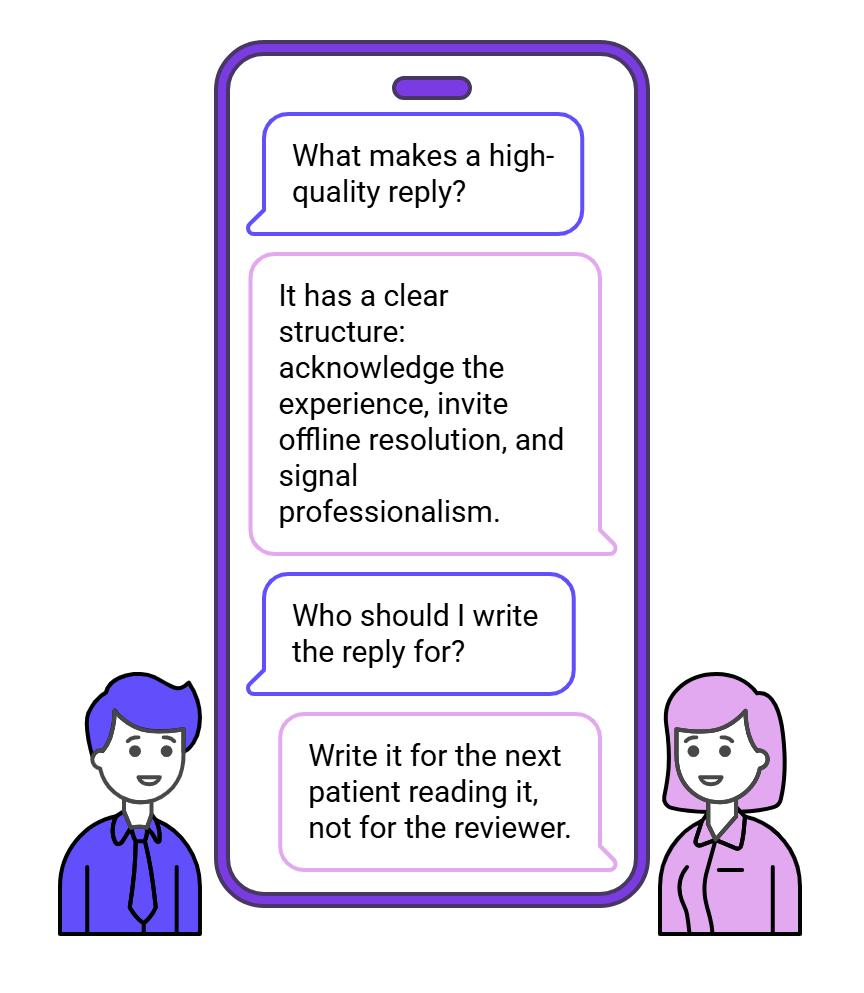
A high-quality reply has a clear structure:
- Acknowledge the experience (without admitting fault or confirming patient identity)
- Invite offline resolution (one clear channel, calm tone)
- Signal professionalism to future readers (policies, standards, or commitment to care)
Think of the reply as being written for the next patient reading it, not for the reviewer.
Step 4: Use one of these proven templates (by scenario)
Below are templates you can adjust to your clinic voice. They’re intentionally steady and professional, not salesy.
Template A: Generic 1-star with no details
“Thank you for the feedback. We’re sorry to hear your experience didn’t meet expectations. We take concerns like this seriously and would appreciate the opportunity to learn more and address it directly. Please contact our office so we can look into what happened and work toward a resolution.”
Template B: Wait time / scheduling frustration
“Thank you for your review. We’re sorry to hear the visit felt frustrating. We work hard to stay on schedule while giving each patient the time they need, and we understand delays can be disruptive. If you’re open to it, please contact our office so we can learn more about your visit and improve our process.”
Template C: “Didn’t help” / disappointed with results
“Thank you for sharing this. We’re sorry to hear you didn’t feel the visit helped. Every case is different, and we aim to set clear expectations around timelines and care plans. We’d appreciate the chance to speak with you directly and understand what happened so we can address your concerns.”
Template D: Billing / insurance confusion
“Thank you for your feedback. We’re sorry there was frustration around billing or coverage. Because we can’t discuss specifics publicly, we’d like to help resolve this directly. Please contact our office and we’ll review everything with you.”
Template E: Staff interaction / professionalism complaint
“Thank you for bringing this to our attention. We’re sorry to hear you felt the experience was unprofessional. We hold our team to high standards and would like to understand what happened so we can address it appropriately. Please contact our office so we can follow up.”
Step 5: Strengthen the review engine (ethically)
A single 1-star review hurts the most when you don’t have recent positive reviews to balance it out. The fix is not to “bury” it. The fix is to build steady review velocity.
If you already have a consistent review request system, a 1-star is annoying—but it won’t dominate your profile.
If you don’t, this is your sign to build one. Reviews support local visibility, conversion rate, and trust—all of which are core to getting new chiropractic patients consistently in 2026.
https://spinealytics.co/how-to-get-new-chiropractic-patients-in-2026/
And as discovery changes (AI summaries, generative search, map results evolving), trust signals become even more central. That’s a big theme in our GEO discussion: modern visibility isn’t just ranking—it’s credibility. Reviews are credibility at scale.
https://spinealytics.co/geo-the-future-of-marketing-for-chiropractors/
The bottom line: your reply is part of your brand
A 1-star review feels personal because you care. That’s normal. But reputation management is a professional skill—one that protects your clinic’s growth engine.
Respond calmly. Move it offline. Improve the system. Keep reviews consistent so one negative doesn’t become the headline of your online presence.
And if you’re trying to build demand that doesn’t depend on seasonal spikes, this is exactly the kind of “boring but powerful” foundation work that keeps momentum steady all year.
Because the goal isn’t to never get a bad review. The goal is to have a clinic brand that handles hard moments with the same confidence it handles the easy ones.