

Let’s keep this simple. SEO gets you found.
But in 2026, getting found is not the win. It’s the entry fee.
Because what happens now?
People land on your site and they still do not book.
They still do not call.
They still do not trust you.
They go right back to the search results. They check reviews. They stalk your socials. They look for proof you’re real. They ask a friend. They scroll Reddit. They watch a 12-second video from some random person who “seems honest” and somehow that becomes the deciding factor.
So yeah, rankings matter. But rankings alone don’t close.
The new game is: visibility + trust, everywhere people look.
That’s your content ecosystem.
The 2026 reality check (why “just SEO” is a trap now)
1) Search is becoming an answer engine, not a traffic engine
When Google shows AI summaries, people click out less. Pew Research found users were less likely to click links when an AI summary appeared (8% vs. 15%).
So if your entire plan is “rank and wait,” cool. That plan is living on borrowed time.
2) “Trust” is the filter, and Google’s telling you that directly
Google’s own guidance pushes “helpful, reliable, people-first content” and explicitly points creators to E-E-A-T.
And Google’s Search Quality Rater Guidelines overview spells it out: raters consider E-E-A-T, including trust, accuracy, honesty, safety, reliability.
Translation: you don’t win by publishing more. You win by being more believable.
3) Social is search now (especially for younger buyers)
Gen Z is actively using Instagram and TikTok as search tools. Forbes has reported this shift toward “social search” behavior among 18–24 audiences.
And for local businesses specifically, BrightLocal shows people use platforms like Instagram and TikTok to find local business reviews too.
So if you’re invisible on social, you’re invisible in part of the buyer journey.
What a “content ecosystem” actually is
A content ecosystem is not “posting more.”
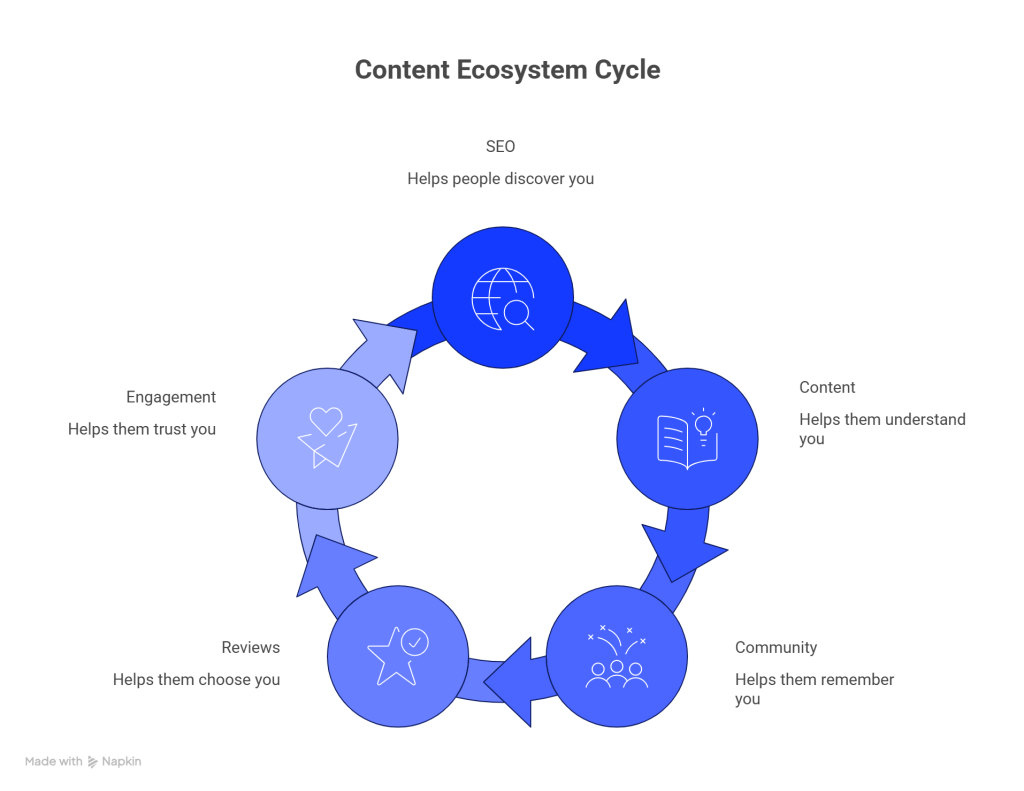
It’s a connected loop where:
- SEO helps people discover you.
- Content helps them understand you.
- Online community helps them remember you.
- Reviews help them choose you.
- Engagement on social helps them trust you.
Or in one line: SEO gets you found, content + social get you chosen.
The 5 parts of an ecosystem that actually builds trust
1) One core message (stop sounding like everybody)
If your website and socials read like a generic brochure, you’re not building trust, you’re blending in.
Your core message should answer:
- Who do you help?
- What do you help them do?
- Why should they believe you?
Then everything else supports that.
2) Proof content (because trust is borrowed, not claimed)
People trust other people more than ads. Nielsen reports 88% of respondents trust recommendations from people they know more than any other channel.
So your ecosystem needs proof on repeat:
- Reviews (with detail, not fluff)
- Case studies
- Before/after (when appropriate)
- Testimonials (video > text)
- “Here’s exactly what happens when you work with us” walkthroughs
Bonus: BrightLocal’s research consistently shows reviews are a major part of local decision-making.
3) Short-form video (the trust speedrun)
Short-form video is the quickest way to feel like a real human business.
Hootsuite’s 2026 stats call short-form video one of the most influential types of social content.
And HubSpot compiles research showing consumers often prefer short video to learn about products or services.
What to post (simple, effective):
- “Here’s what most people get wrong about _”
- “If you’re dealing with _, do this first”
- “3 signs you should stop waiting on this”
- “What to expect on your first visit / first call”
- “We tried X, it didn’t work, here’s what did”
Not cinematic. Not perfect. Just clear.
4) Community and local presence (offline still wins, if you amplify it)
If you serve a local market, community is your cheat code:
- local sponsorships
- events
- partnerships with complementary businesses
- local groups and associations
- local charity support
Then you turn it into content:
- photos
- short clips
- mini interviews
- recap posts
- “we’re here” proof
This is how you stay top-of-mind without begging for attention.
5) AI repurposing (yes, use AI… but don’t publish garbage)
AI should help you move faster, not help you publish nonsense.
There’s a difference between:
- AI as a repurposing assistant
- AI as a content slot machine
If you’re pumping out “crappy little blog posts” with no value, it’s not a strategy, it’s noise.
Here’s the right way to use AI:
Create one strong “pillar” piece (weekly or biweekly):
- a blog
- a case study
- a Q&A page
- a short recorded talk (10 minutes)
- a client FAQ breakdown
Then repurpose it into:
- 5–7 short videos (hooks pulled from the pillar)
- 1 carousel (steps, checklist, myth vs fact)
- 3 simple text posts
- 1 email
- 1 Google Business Profile post
- 1 “community” post (tie-in to something local)
Same ideas. Different formats. Different surfaces.
That’s how you build omnipresence without burning out.
A simple 30-day ecosystem plan (no fluff)
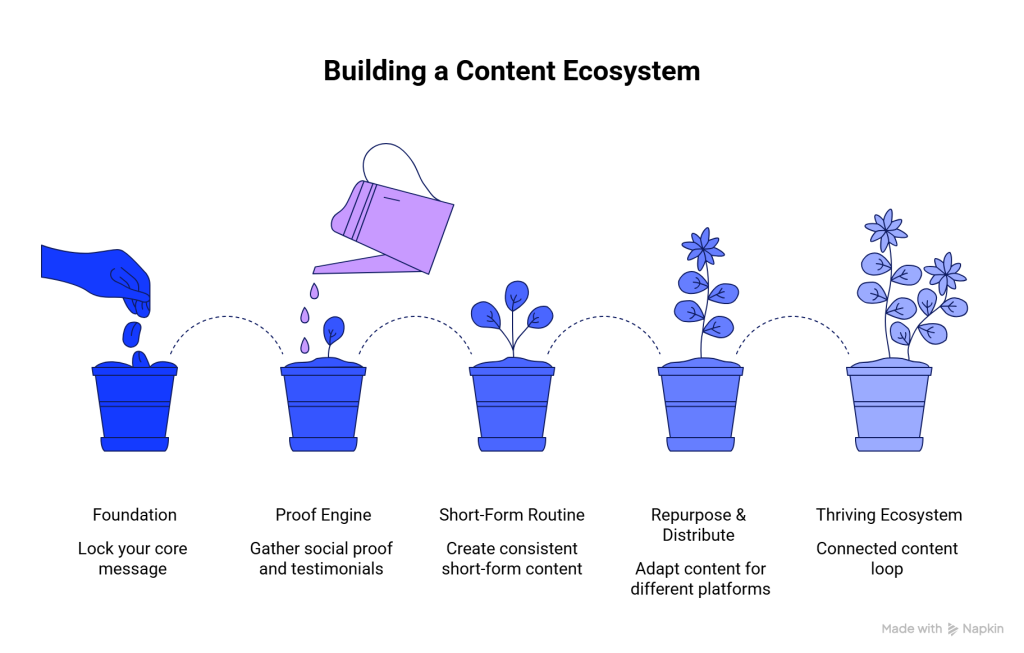
Week 1: Foundation
- Lock your core message (one paragraph)
- Create or update:
- About page (make it human)
- Services pages (clear outcomes + process)
- Reviews strategy (ask flow + link + cadence)
Google wants “helpful, reliable” content created for people, not content made to manipulate rankings.
Week 2: Proof engine
Pick 3 proof assets to build:
- 1 case study
- 1 testimonial video request
- 1 “what to expect” walkthrough post
Week 3: Short-form routine
Film 10 clips in one sitting:
- 5 education
- 3 objections
- 2 proof stories
Post 3 per week.
Week 4: Repurpose and distribute
Turn your pillar into the full repurpose stack
Put your content in the same places buyers verify you:
- TikTok (if relevant)
- YouTube Shorts
- Google Business Profile
“Okie dokie,” now you’re not just trying to get seen. You’re building familiarity.
The metric that actually matters: branded demand
In 2026, one of the biggest wins is when people stop searching “service near me” and start searching your name.
That’s how you escape the price-shopping cage.
SEO helps you show up.
Content + social helps you become the obvious choice.
And when you do it right, the result is boring in the best way: it just works. It “needs a little more love,” then it compounds.