

How to Ask for Reviews Successfully Without Feeling Awkard
Let’s be honest: asking for reviews can feel weird.
Not because reviews don’t matter (they do), but because the moment you try to “make the ask,” your brain immediately supplies a dozen awkward questions:
Do I ask in the room or at the front desk?
Do I wait until they’re feeling better?
Is it my job—or should reception handle it?
Is a sign by the checkout enough?
What if they say no?
What if they leave a bad one?
All valid. All common. And all solvable.
Reviews are one of the most reliable ways to grow your online presence because they do something your marketing can’t do on its own: they borrow trust from real people in your community. A strong review profile makes your clinic feel safer, more established, and more “obviously the right choice” to someone who’s never met you.
And reviews don’t just make your clinic look good. They act as a trust signal at every stage of the patient journey.
They help with:
Decision-making: Patients compare clinics based on review quality, quantity, and recency.
Local visibility: A steady flow of new reviews supports local search performance and improves click-through rates from Maps.
Conversion rate: A clinic with recent, specific reviews feels safer. Safety leads to action.
Messaging: Reviews hand you the language patients actually use to describe outcomes—great fuel for your website and ads.
If you want consistent new patient flow, reviews can’t be a once-in-a-while push. They need to become a weekly operating system—quiet, consistent, and repeatable.

Why asking feels awkward
Most discomfort comes from the same place: you don’t want to feel like you’re asking for a favor.
And that makes sense. In regular social life, asking for public praise isn’t exactly a smooth move.
But in a clinic setting, a review isn’t really “praise.” It’s feedback. It’s the digital version of a patient telling a friend, “That place helped me. Go there.”
If you can treat the review request as a simple invitation—something patients can do—the awkwardness drops fast.
The bigger issue is not whether reviews matter. It’s whether you’ve found a moment where asking feels natural.
So let’s talk timing.
Timing: the “win moment” is your best friend
There are a few good times to ask for a review, but one moment consistently beats the rest:
The win moment is them saying "Thank you."
It can be reduced pain, better sleep, improved range of motion, a milestone, or a slight better mood, patients will say, “That helped a lot”, “I’m so glad I came in”, or simply, “Thank you.”
That last one is the golden ticket. Because “thank you” is already a gratitude moment. Your job is to give them a simple way to do something with that gratitude.
Here’s the line that turns an awkward ask into a natural response:
“One of the best ways to say ‘thank you’ is by leaving us a Google review.”
It’s short, warm, and it makes sense in the flow of conversation. You’re not interrupting the appointment to ask for something random. You’re responding to what they just said.
And yes, sometimes it works so well they’ll pull out their phone on the spot. That’s not because you pressured them. It’s because you made the next step obvious and easy.
Who should ask?
Doctors hear the win moment in real time. That makes the ask feel personal and relevant. It also carries weight because it comes from the person delivering care.
Front desk can do what keeps the system consistent: sending the link, reminding when appropriate, and keeping a simple weekly rhythm.
The most reliable approach is a “two-touch” system.
Don’t ask too early
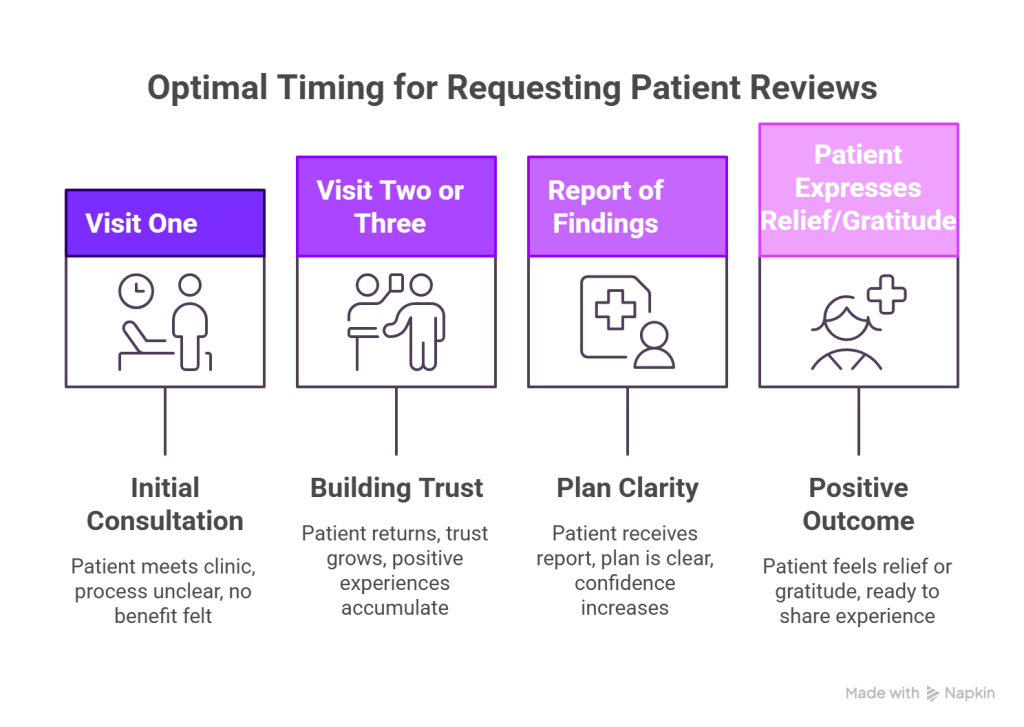
A common mistake is asking on visit one, before the patient understands the process or has felt any real benefit. That can put them in an awkward position: they don’t know what to say yet.
Reviews are easier when the patient has had time to build trust and collect a few positive experiences. For many clinics, that sweet spot is:
*after the second or third visit
*after the report of findings, once the plan is clear
*after a patient expresses relief or gratitude
In other words: give the relationship enough time to become real. A review should feel like a natural reflection of experience, not a premature endorsement.
The SMS/email approach: keep it simple, not robotic
Here’s why people don’t leave reviews: they forget, they get busy, or they can’t find the link later.
The best system is: ask in person, then send one clean message with one link.
The golden rule: one link, one action
Do not send multiple links. Do not ask for Google + Facebook + Yelp + “wherever you prefer.” That sounds small, but it creates decision friction. Patients will choose… not to choose.
Pick your priority platform (for most clinics, it’s Google) and get consistent.
SMS template
Send within 1–2 hours of the appointment while the experience is still fresh:
“Hi [Name] — thanks for coming in today. If you’re feeling a bit lighter after your visit, would you leave a quick Google review? It really helps other patients find us. Here’s the link: [Link]”
That’s it. No essay. No guilt. Just a friendly nudge and a clear next step.
Email template
Email still works well for patients who live in their inbox (and for clinics where email is already the primary channel).
Subject line ideas:
“Would you share your experience?”
“A quick 1-minute favor”
“[Clinic Name] needs your help!”
“Want to say thank you to your neighborhood clinic?”
Email body:
“Hi [Name],
Thanks for clicking on this email. If you feel we’ve taken good care of you, we’d really appreciate a quick Google review. It helps new patients who are dealing with similar issues feel confident booking their first visit.
Here’s the link: [Link]
Thank you,
[Clinic Name]”
What about signage?
A QR code sign at the front desk is great. It captures the “I can do it right now” patient. It also reminds people who already intended to leave one.
But signage alone is passive. Passive systems don’t create consistent review velocity.
Ask during win moments, not randomly.
Send the SMS/email within a couple of hours.
Respond to every review (yes, even the short ones).
This matters beyond reputation. Reviews are one of the few marketing assets that strengthen multiple areas at once: local visibility, conversion rate, and trust.
If you’ve read our breakdown on building predictable demand (instead of relying on seasonal spikes), you’ll recognize reviews as one of the most stable “always-on” growth levers you can run year-round. The same is true if you’ve felt the whiplash described in our January rush analysis—reviews help smooth out those peaks and valleys by keeping trust and visibility steady.
Reviews don’t just build trust. They build searchability.
One of the most underrated benefits of reviews is the language you get back.
Patients will describe outcomes in a way you would never write as a clinician, but that’s exactly why it’s valuable. Their words often match how people search online and how people talk to friends. Those phrases can strengthen:
- your homepage messaging
- your service page copy
- your ads
- your social content
If you’re working through a broader growth plan (like our “how to get new chiropractic patients in 2026” approach or the “ultimate digital marketing checklist” style of clinic system-building), reviews are not a side quest. They’re a core input that improves everything else.
And as search continues to evolve—especially with AI-driven discovery and the shift toward generative results—trust signals become even more important. That’s a big theme in our GEO discussion (Generative Engine Optimization): the clinics that show up more often are the clinics that look most trustworthy, most consistent, and most validated by real humans.
Reviews are the simplest proof you can accumulate.
The bottom line
If asking for reviews feels awkward, it’s usually because you’re trying to force the moment.
Instead, wait for the moment that’s already there: gratitude, relief, progress; then give the patient a natural way to act on it.
Use a simple line like:
“One of the best ways to say ‘thank you’ is by leaving a Google review.”
Follow it up with one clean SMS or email. Keep it human. Keep it consistent. Keep it on brand.
And over time, something shifts: reviews stop being a “marketing thing” and start becoming part of how your clinic grows in the background. Quietly building trust, visibility, and momentum.