

SEO, AEO, Google Ads, and Meta: A Plain-English Guide to Where Your Patients Actually Are
Most chiropractors pay for marketing every month without a clear picture of what they're actually buying.
The result isn't just confusion. It's a measurable number of patients walking into competitors' offices instead of yours.
This post explains the four channels in plain English, what each one actually does, and how many patients are passing through each one in a typical service area.
Setting the scale
The typical chiropractic practice serves a 5 to 7 mile radius around the clinic.
Depending on where you're located, that radius covers:
- Low-density suburban areas: roughly 75,000 to 150,000 people
- Typical suburban areas: 150,000 to 300,000 people
- Urban or dense suburban areas: 400,000 to 700,000+ people
For most clinics, a defensible working number is 150,000 to 300,000 people in your service area. We'll use 200,000 as the example throughout this post. Roughly 150,000 of those are adults.
Your service area almost certainly contains more potential patients than you've served in your entire career, combined.
How the four channels actually work
There are two types of marketing channels, and confusing them is where most marketing budgets go wrong.
Demand capture (SEO and AEO): patients are already looking for help. Your job is to be findable.
Demand creation (Meta): patients aren't looking. You're interrupting them while they scroll.
Google Ads sits in between. Patients are searching, and you pay to skip the line in front of them.
The reason ROI varies so dramatically across these channels is that they're doing fundamentally different jobs.
Channel 1: SEO (search engine optimization)
What it is: Showing up when people search Google for chiropractic-related help.
How it works: Google ranks websites by relevance, authority, location signals, and how real users behave on the page. The top 3 results in the local map pack capture the majority of clicks.
The volume in your area:
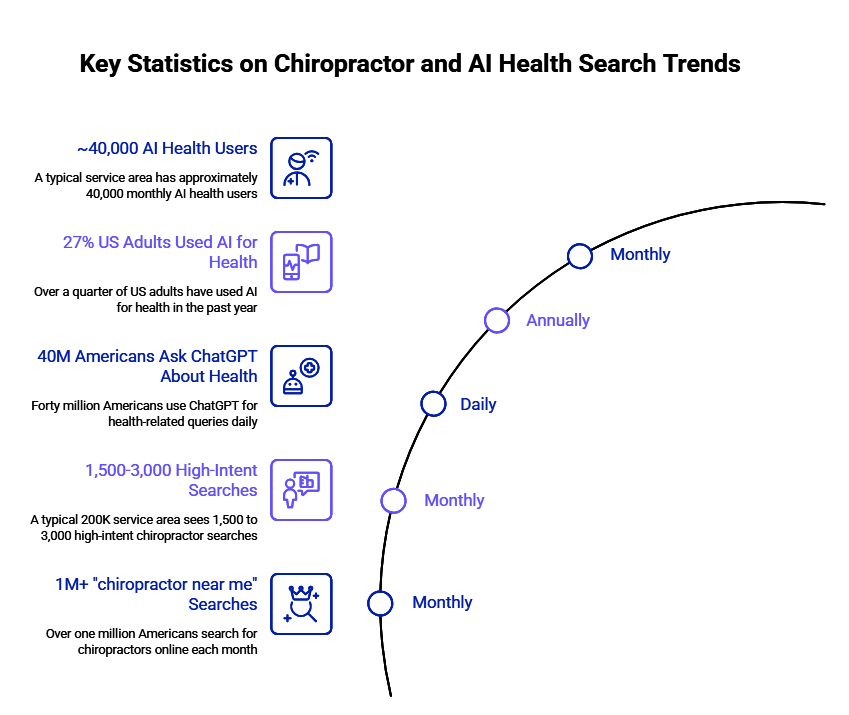
- "Chiropractor near me" gets over 1 million searches every month nationally
- Applied to a 200,000-person service area, that's roughly 600 monthly searches for that one term alone
- Adding back pain, neck pain, sciatica, headaches, sports injuries, prenatal care, and city-specific variants brings the total to 1,500 to 3,000 high-intent searches per month
These are not casual browsers. People searching "chiropractor near me" or "back pain treatment" are in pain right now and ready to book.
The dollar math at $2,000 average patient value:
- Capturing 1% of that demand: $30,000 to $60,000 per month
- Capturing 2%: $60,000 to $120,000 per month
- Capturing 2% over 12 months: $720,000 to $1.4M annually
Why most chiropractors lose here: Template websites cannot compete for the top 3 spots. 97% of consumers search online for local businesses, and over 60% of healthcare searches happen on mobile. A slow, generic website on a mobile screen loses every time.
One important note before we move on: The foundation work that wins SEO is the same foundation work that wins in AI search (covered in the next section). Strong content, clear authority signals, and a well-structured site improve both at once. The two channels reward the same investment, which is why we're covering them back to back.
Channel 2: AEO (Answer Engine Optimization)
Also called GEO (Generative Engine Optimization). The terms are used interchangeably and refer to the same work.
What it is: Showing up when people ask AI tools (ChatGPT, Perplexity, Gemini, Google's AI Overviews) for help.
How it works: AI tools cite sources based on authority, content quality, and structured information. They give patients a shortlist of recommendations, not a page of ten blue links. AI tools do not show ads.
The volume in your area (and this is the part most chiropractors don't realize yet):
- More than 40 million Americans use ChatGPT every day to ask healthcare questions, and one in four of ChatGPT's regular users submits a healthcare-related prompt every week
- About 32% of US adults turned to AI chatbots for health information in the past year, with 29% specifically using AI for physical health questions
- Applied to a 200,000-person service area: roughly 43,500 monthly AI health users
- Roughly 25 to 30% of those are dealing with pain, mobility, or injury (the conditions chiropractors treat): about 10,000 to 12,000 people per month
- Of those, about 2,500 to 3,000 are asking questions specific enough to surface a local recommendation
What people are actually using AI for:
- 55% used AI to check or explore symptoms, 48% used it to understand medical terms or instructions, and more than 40% used it to learn about treatment options
- Most users cited a desire for quick and immediate advice, with 41% looking up information before seeing a provider
The dollar math:
- Capturing 1% of relevant AI queries: $50,000 to $60,000 per month
- Capturing 1% over 12 months: $600,000+ annually
Why most chiropractors lose here: AI doesn't cite generic websites. The clinics being recommended are the ones with real content, clear authority signals, and answers to the questions patients are actually asking.
Channel 3: Google Ads
What it is: Paying to appear at the top of Google for specific search terms.
How it works: Auction-based bidding. You pay every time someone clicks, whether they book or not.
The cost of being visible:
- Typical US cost-per-click for local chiropractor search terms runs $2.50 to $8.00, with highly competitive markets reaching $10 to $25 on top intent keywords
- Cost per lead typically falls between $30 and $200+ depending on funnel quality, with most metro areas needing $1,500 to $3,000 minimum monthly budget to gather meaningful data
- The average chiropractor spends around $500 a month on Google Ads, which is generally considered too low to be competitive
The hidden limitation:
Google Ads do not appear in AI search results.
Every patient who shifts their research from Google to ChatGPT (and that's a growing share every month) is a patient your ad budget cannot reach.
You're paying premium prices in a channel that's getting smaller.
Channel 4: Meta Ads (Facebook and Instagram)
What it is: Paid placements on Facebook and Instagram, targeted by demographics and interests.
How it works: Interruption-based. People aren't searching for healthcare when they're scrolling. You're betting your ad will catch them at a moment when they happen to care.
The cost of being visible:
- Healthcare CPMs on Facebook averaged $27.30 from January 2025 through January 2026, versus a $19.81 global all-industry average. Costs climbed from $22.76 in January 2025 to $38.70 by January 2026, a 70% rise from start to finish
- Service-based verticals like healthcare commonly see costs per lead in the $30 to $50+ range
The reach in your area:
- A 200,000-person service area gives Meta roughly 150,000 adult scrollers to interrupt
- Highest volume reach of any channel, by far
- Lowest intent of any channel, by far
The hidden cost: The patients who actually convert on Meta ads are typically the lowest-lifetime-value segment. They're price-driven, intro-special-shoppers, and they don't stick.
The volume comparison
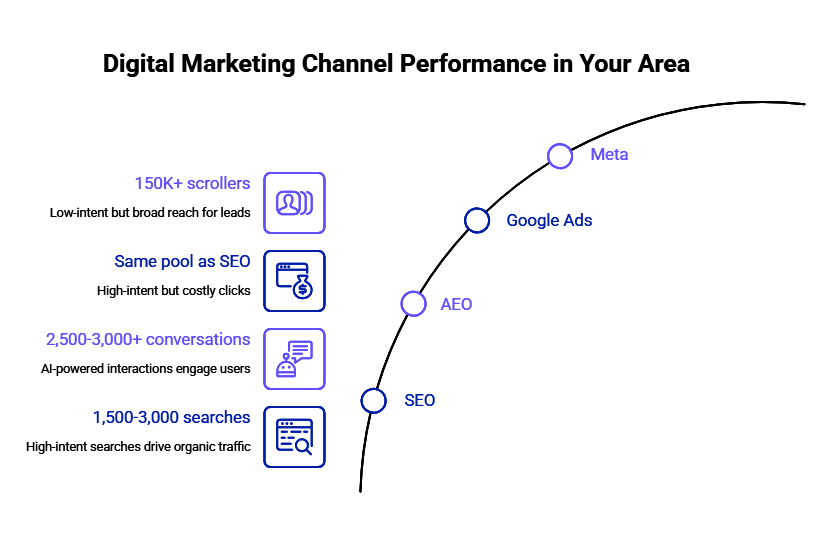
Side by side, in a typical 5 to 7 mile radius:
| Channel | Monthly volume | Intent | Cost to be visible |
|---|---|---|---|
| SEO | 1,000 to 2,500 searches | Very high | Foundation work |
| AEO | 3,000+ AI conversations | Very high and growing | Foundation work |
| Google ads | Same pool as SEO | High but paid | $5.26+ per click |
| Meta ads | 60,000+ scrollers | Low | $30 to $50+ per lead |
The dollar math at $2,000 per patient:
- SEO at 2% capture: $720K per year potential
- AEO at 1% capture: $480K per year potential
- Combined demand-capture potential: over $1 million per year
Most chiropractic marketing budgets are upside down. The largest, highest-intent channels are the ones receiving the smallest investment.

What this means
This isn't an argument against running ads.
It's an argument for understanding what each channel actually does before you decide where your money goes.
The two largest patient-demand channels in your area, SEO and AEO, both reward foundation work. Real content. Clear structure. Authority signals. The kind of website that gets cited by AI and ranks in Google's top three.
The two paid channels can amplify a strong foundation. They cannot replace one.
The patients are out there. The question is whether your practice exists in the channels they're already using.
References and sources
On AI health usage
OpenAI report on ChatGPT health usage (40 million daily health users, 1 in 4 of 800M users submit health prompts weekly, 5%+ of all messages globally are health-related): Healthcare Dive coverage: https://www.healthcaredive.com/news/40-million-use-chatgpt-health-questions-openai/808861/ Becker's Hospital Review coverage: https://www.beckershospitalreview.com/healthcare-information-technology/ai/40m-americans-turn-to-chatgpt-for-healthcare-report/ Axios coverage: https://www.axios.com/2026/01/05/chatgpt-openai-health-insurance-aca
OpenAI/Knit survey (3 in 5 US adults used AI for healthcare in past 3 months; 55% for symptoms, 48% for medical terms, 40%+ for treatment options): Same OpenAI report, covered in Healthcare Dive link above
KFF Tracking Poll on Health Information and Trust, March 2026 (32% of US adults used AI for health info in past year, 29% for physical health): https://www.kff.org/public-opinion/kff-tracking-poll-on-health-information-and-trust-use-of-ai-for-health-information-and-advice/
KFF press release on the same data: https://www.kff.org/health-information-trust/poll-1-in-3-adults-are-turning-to-ai-chatbots-for-health-information-equaling-the-share-who-use-social-media-for-health/
West Health-Gallup Center on Healthcare in America poll (roughly 1 in 4 US adults used AI for health in past 30 days): PBS News coverage: https://www.pbs.org/newshour/health/why-so-americans-are-using-ai-for-health-guidance
On Google Ads costs for chiropractors
Chiropractic-specific CPC data ($2.50 to $8 typical, $10 to $25 in competitive markets, $1,500 to $3,000 minimum monthly budget): Marketing source data compiled from chiropractic Google Ads agencies (rates verified across multiple industry sources)
Chiropractic Google Ads spending benchmarks (average chiropractor spends ~$500/month, generally too low to compete): Industry benchmark from chiropractic-focused PPC agencies
Healthcare industry Google Ads averages ($3.13 average CPC, 3.82% search network CTR): WordStream / industry benchmark reports
On Meta Ads costs for healthcare
Facebook healthcare CPMs ($27.30 average January 2025-January 2026, climbing 70% from $22.76 to $38.70): Industry CPM benchmark reports for paid social healthcare verticals (2025-2026)
Healthcare cost-per-lead benchmarks ($30-50+ range): Service-vertical CPL benchmarks from major paid social platforms
On local search behavior
Local search statistics (97% of consumers search online for local businesses, 60%+ of healthcare searches on mobile): Local SEO industry research from BrightLocal and Google's own consumer search reports
Google Local Pack and click-through behavior (top 3 capture majority of clicks): SEO industry research from Moz and BrightLocal
"Chiropractor near me" national search volume (1M+ monthly): Keyword research data from major SEO tools (Ahrefs, SEMrush, Google Keyword Planner)
On population density
US suburban density averages (2,700 people per square mile suburban, 7,700 urban, 3,100 overall US urban area average): Demographia International Population Density Reports: http://demographia.com/db-intlsub.htm
Suburban density classifications: Thesis Driven analysis on US population density: https://www.thesisdriven.com/letters/on-population-density/
FiveThirtyEight analysis of urban/suburban/rural classification: https://fivethirtyeight.com/features/how-suburban-are-big-american-cities/
Note on data interpretation
All volume estimates and dollar projections in this post are calculated using conservative capture rates and the lower-to-middle range of available data. Actual results vary based on practice location, service area density, competitive landscape, marketing execution quality, and patient lifetime value. The numbers presented are intended as directional benchmarks for understanding channel scale, not as guarantees of specific outcomes.