

The Page That Gets Cited (And the One That Gets Ignored)
AI FRONT DOOR · 04
There is a version of your website that AI recommends to patients. And there is a version that AI skips entirely.
Most chiropractors have the second version.
Not because their care is bad. Not because their site looks unprofessional. Because the page gives AI nothing concrete to work with. No specifics. No structure. No signal that this practice is the right answer for this patient in this city.
AI search does not browse your website the way a curious patient might. It extracts. It pulls structured, verifiable, specific information and uses that to construct recommendations. If your page cannot be extracted from, it cannot be cited. If it cannot be cited, it does not exist in AI search results.
That is the gap this article is about. Not "we have a website" versus "we do not." The gap between having a website and having a page AI can actually use.
What It Means to Be Citable
Citability is not a design quality. It is not about how your site looks or how fast it loads. It is about whether AI systems can find clear, specific, structured answers on your page and tie those answers to a real practice in a real place.
Think about what happens when someone types "best chiropractor for disc herniation in Cleveland" into ChatGPT or Google AI Overviews. The AI is not browsing a directory. It is pulling from pages that contain concrete information about disc herniation treatment, structured in a way that is readable by machines, tied to a geographic location, and associated with a credentialed practitioner.
A page that says "we treat neck and back pain with a patient-centered approach" tells AI nothing it can use. A page that says "Dr. Sarah Kowalski, DC, specializes in lumbar disc herniation and cervical radiculopathy for patients in the Tremont neighborhood of Cleveland, with a focus on avoiding surgery through specific chiropractic adjustments and functional rehab" gives AI something to work with.
Specificity is not just good marketing. It is the raw material AI needs to recommend you.
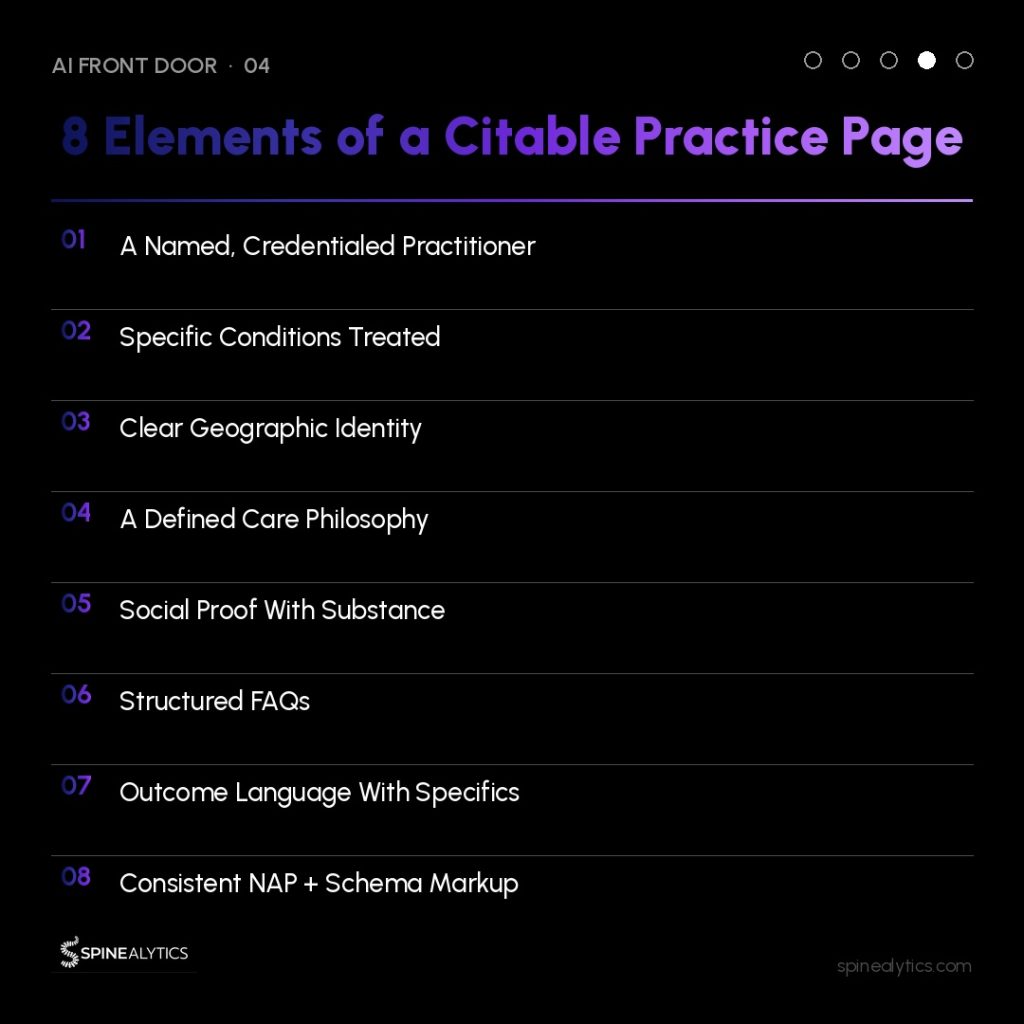
The Eight Elements of a Citable Practice Page
These are not suggestions. Each element below is a signal AI systems look for when deciding whether a page is worth referencing. The more of these your page has, the more citable it becomes.
1. A Named, Credentialed Human
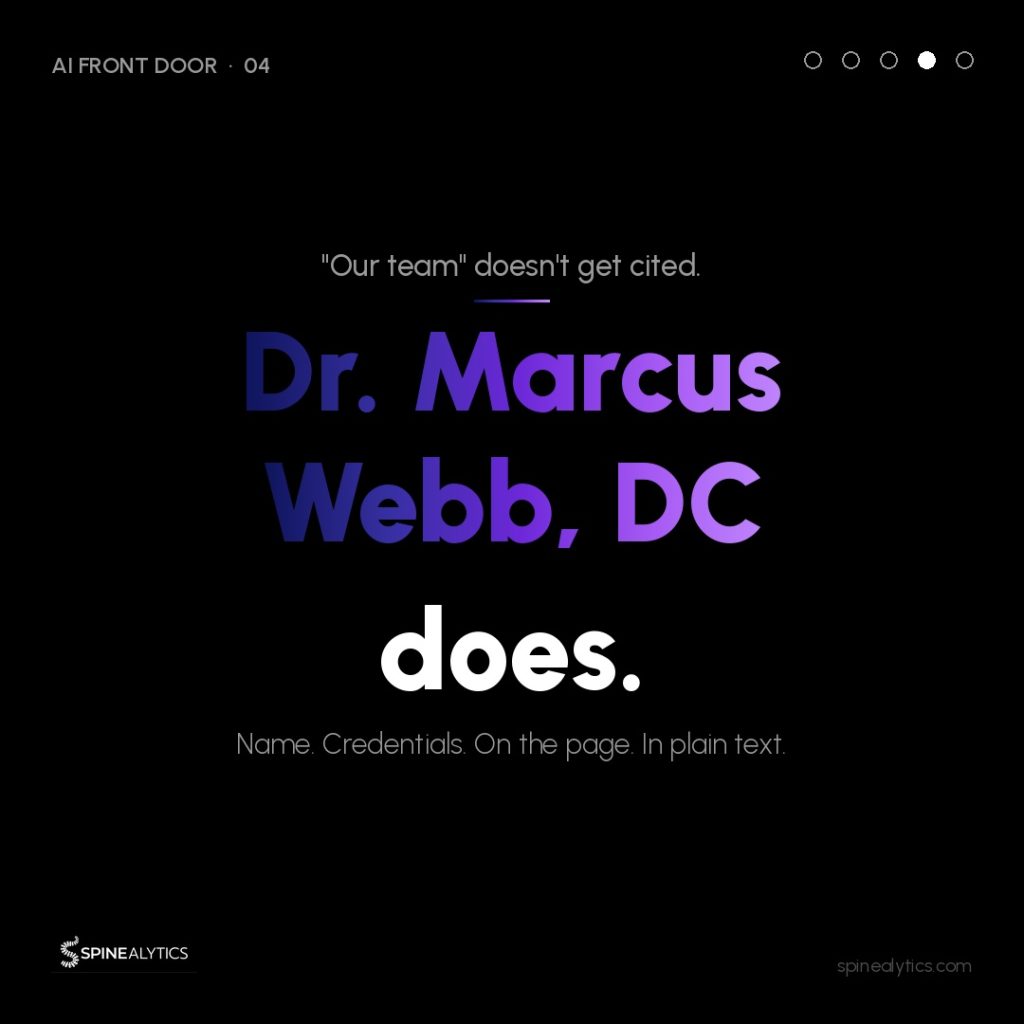
"Our team" does not get cited. Dr. Marcus Webb, DC, does.
AI needs a real person to attach expertise to. Your name, your credentials, and your years of experience need to be on the page in plain text. Not buried in a PDF bio or hidden in a staff photo caption. On the page. Readable.
2. Specific Conditions Treated
"We help with pain" is not citable. "We treat patients with lumbar disc herniation, cervical radiculopathy, and chronic tension headaches" is.
Name the conditions. Use clinical language where appropriate. AI models are trained on the same terms patients type into search engines. The closer your language matches the patient's question, the more likely your page appears in the answer.
3. Clear Geographic Identity
Your city is not enough. Neighborhoods, landmarks, and suburbs matter.
A practice in Miami that mentions Brickell, Coral Gables, and Coconut Grove is more citable than one that says "serving the Miami area." AI narrows recommendations geographically. Help it narrow to you.
4. A Defined Care Philosophy or Approach
This is not a mission statement. This is a specific answer to the question: "How do you treat patients differently than the chiropractor down the street?"
Structure-based care. Cox flexion-distraction. Specific spinal correction protocols. Whatever your approach is, name it and explain it in plain language. AI uses this to match practice philosophy to patient intent.
5. Social Proof With Substance
Star ratings are noise. Patient outcomes are signal.
"We have hundreds of five-star reviews" tells AI nothing. "Patients with sciatica typically see meaningful improvement within eight to twelve visits, and many of our patients have avoided recommended surgeries" gives AI something it can reference when a patient asks whether chiropractic works for their specific problem.
6. Structured FAQs That Mirror Real Patient Questions
This is one of the most underused tools in chiropractic marketing.
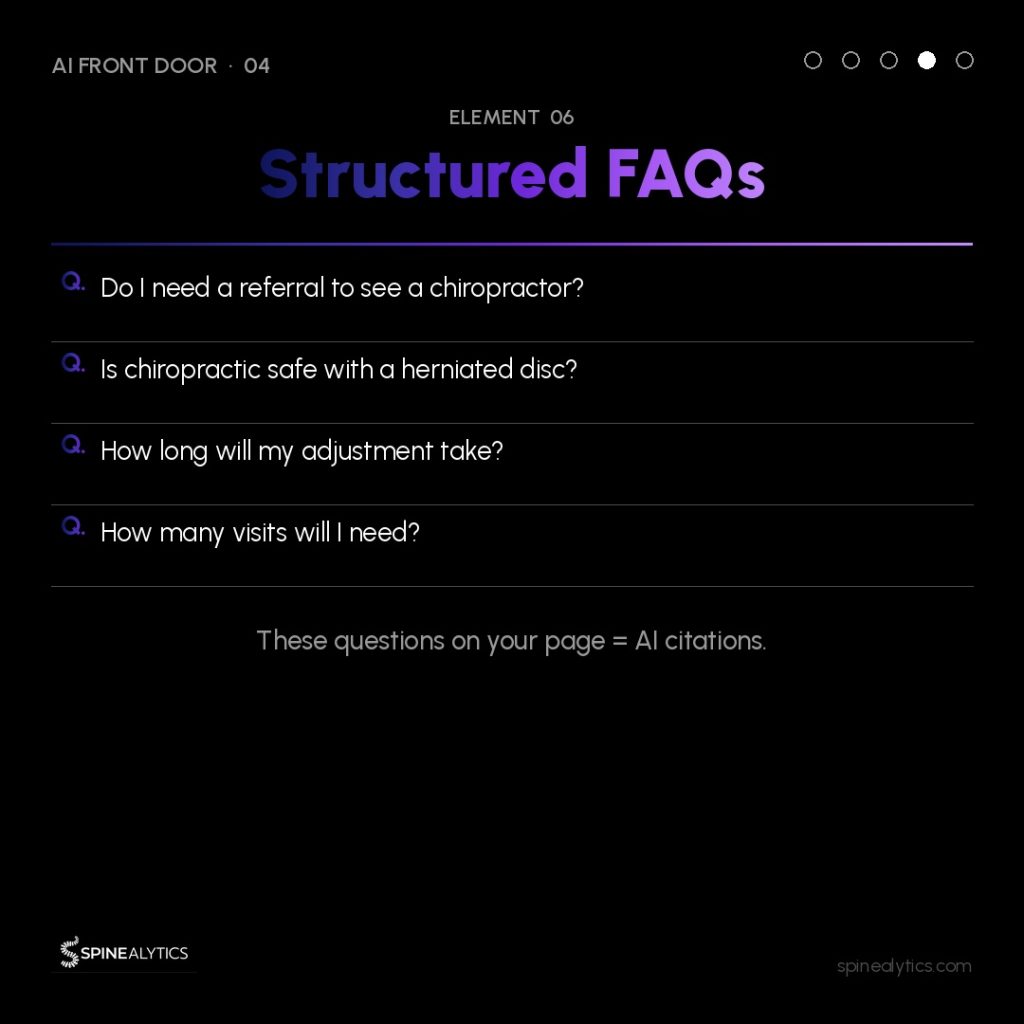
AI Overviews, ChatGPT, and Perplexity are essentially answering machines. They love pages that already contain questions and answers in a clear format. Write FAQ sections using the exact language your patients use when they call the front desk or type into Google. "Do I need a referral to see a chiropractor?" "How long will my adjustment take?" "Is chiropractic safe if I have a herniated disc?" These questions, answered clearly on your page, make your site a source AI wants to pull from.
7. Outcome Language and Specifics
Vague promises do not get cited. Specific, plausible outcomes do.
You do not need to make guarantees. You need to paint a realistic picture. How many visits does a typical new patient plan look like? What can a patient with your most common presenting complaint expect in the first four weeks? Quantified, honest, specific language reads as authoritative to AI systems.
8. Consistent NAP and Schema Markup
NAP stands for Name, Address, and Phone. It needs to be identical everywhere your practice appears online. Your website, your Google Business Profile, your directory listings. Inconsistency creates ambiguity, and AI avoids ambiguous sources.
Schema markup is the technical layer that tells search engines what your page is about in structured code. LocalBusiness schema, MedicalOrganization schema, and FAQ schema are the three most important for chiropractic practices. This is not a do-it-yourself project, but it is also not optional if you want to compete in AI search.
The Page Nobody Wants to Write
Here is the honest problem. Most chiropractors know their website needs work. They just do not know exactly what "work" means, and the people they have trusted with their website have not told them.
Web developers build pages that look good. SEO vendors optimize for keywords. Neither of those disciplines was built with AI citability in mind, because AI citability is a new problem.
So the page stays generic. "Welcome to our practice. We treat the whole patient. We accept most insurance. Call to schedule your free consultation." It has been that way for five years. It will stay that way until someone explains exactly what needs to change and why.
That is what you just read.
The chiropractors who move fastest on this have a real advantage. AI search is still being shaped. The practices that build citable pages now are the ones AI learns to reference. The ones that wait are going to be competing against an established pattern they did not help create.
What This Looks Like in the Wild
Two practices. Same city. Same services. Very different citability.
Practice A, Cleveland:
Homepage reads: "Family chiropractic care in Cleveland. We treat neck pain, back pain, headaches, and more. Same-day appointments available. Insurance accepted."
Nothing wrong with it as a website. Everything wrong with it as an AI source. No named practitioner. No condition specificity. No geographic depth. No FAQ content. No care philosophy. No outcome language. AI has no hook.
Practice B, Cleveland:
A dedicated services page for disc herniation includes: the treating doctor's name and credentials, a clear explanation of how the practice approaches lumbar disc cases, typical patient timelines, a FAQ section answering six common patient questions about disc herniation and chiropractic, the specific Cleveland neighborhoods served, and schema markup connecting all of it.
When someone asks ChatGPT who to see for a herniated disc in Cleveland, Practice B has a page that answers the question. Practice A does not.
Now run the same scenario in Miami. Practice A has a homepage that says "serving Miami and surrounding areas." Practice B has a page built around the specific conditions, specific neighborhoods, and specific outcomes that a Miami patient searching for answers would actually use to make a decision.

The gap is not complicated. It is a page. A real one. Built for the way AI search actually works.
What Comes Next
You now know what a citable page looks like and what makes most practice pages invisible to AI. The final piece is what happens after you build it.
Part 5 closes the series with the full picture: how AI search behavior is evolving, what it means to actively manage your AI presence, and what the practices that are winning AI referrals are doing consistently that the rest are not.
That piece is next.