

Website Conversion Basics for Chiropractors
Most chiropractic clinics don’t have a “traffic problem.” They have a conversion problem.
A clinic can be doing all the right things to get visibility—publishing content, running Google Ads, improving local SEO, posting on social—and still feel like the schedule is inconsistent. In almost every audit I’ve done, the gap shows up on the website: visitors arrive with intent, but the site doesn’t help them take the next step with clarity and confidence.
In practical terms, website conversion means turning “interested clicks” into measurable actions: calls, form submissions, online bookings, direction requests, and ultimately, new patient appointments. The good news is that conversion is not a mystery. It’s a system. And once you treat it like a system, you can improve it predictably.
Understand the patient’s intent before you optimize anything
Chiropractic website visitors generally arrive in one of three states of intent.
First, some are problem-aware. They feel pain or limitation and want relief, but they are still figuring out whether chiropractic is the right fit. Second, some are solution-aware. They already want chiropractic care and are comparing clinics based on trust, convenience, and perceived fit. Third, some are clinic-aware. They are ready to book, but they need a frictionless path to do it.
Your website should make it easy for every one of those visitors to move forward. That starts with choosing the “next best step” for each page. A homepage can support multiple actions, but a service page or condition page usually performs better when it has one primary call-to-action (CTA), supported by one secondary option.
If you have pages trying to push three different actions equally, you usually get none of them consistently.
For a broader view of traffic sources and how patients find clinics right now, you may want to pair this with How to Get New Chiropractic Patients in 2026 so your acquisition strategy and conversion strategy stay aligned.
Make “message match” a non-negotiable
Message match is one of the most overlooked conversion levers in chiropractic marketing. It simply means that what the visitor clicked should be immediately confirmed on the page they land on.
If your Google Ad says “Spinal Decompression in Tucson” and the user lands on a generic homepage with no decompression mention above the fold, you’ve created uncertainty. Uncertainty kills conversion.
The same applies to your Google Business Profile, blog posts, social posts, and referral links. When someone clicks, they expect continuity: the same topic, the same promise, the same next step, and the same level of specificity.This is also why “being found” doesn’t automatically translate into results. Visibility is only step one. The second step is building a site experience that converts that visibility into outcomes. If you want the bigger strategic framing, see Why Being Found Isn’t Enough in 2026: Build Your Content Ecosystem.
Use dedicated pages instead of forcing everything through the homepage
Many clinics unintentionally sabotage conversion by sending all traffic to the homepage. Homepages have a role, but they are rarely the best endpoint for paid traffic or condition-based searches.A cleaner conversion approach is to route visitors to pages designed for their intent. If a visitor searches “sciatica chiropractor” they should land on a sciatica-focused page that answers sciatica questions, addresses care approach, includes trust elements, and offers a simple booking path. This is where strong page structure and focused copy matter, and it ties directly into your broader SEO architecture (see Search Engine Optimization for Chiropractors if you want a technical framework for building that out).
Win the 5-second test above the fold
When someone lands on a chiropractic website, they decide quickly whether to keep reading. The top section of your page (especially on mobile) needs to do a specific job: reduce confusion and help the visitor self-identify.
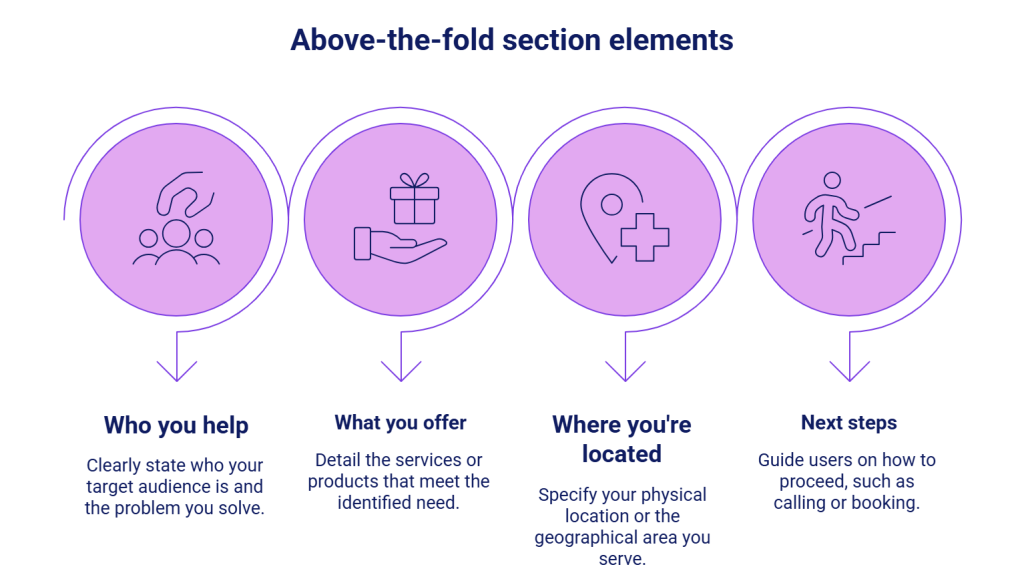
A strong above-the-fold section typically communicates four things in plain language:
- Who you help and what you help with.
- What the clinic offers that addresses that need.
- Where you’re located (or the area you serve).
- How to take the next step (call, book, or request an appointment).
This is not the place for vague brand statements. It’s also not the place for clinical jargon without translation. “Evidence-based care for musculoskeletal dysfunction” might be accurate, but it doesn’t help an anxious patient decide if you can help their sciatica, headaches, or shoulder pain.
Clinics that improve only this section often see conversion lift without changing anything else, because it eliminates the most common first-page friction: “Am I in the right place?”
This is one of the core reasons design and copy cannot be separated. Good visuals without good messaging don’t convert. Good messaging buried in a confusing layout also doesn’t convert. If you want a deeper look at the build side of this, see Web Design & Development for Chiropractors.
Reduce friction in the booking path
Most chiropractic websites lose ready-to-book visitors because the booking path is too hard, too long, or too unclear. A conversion-friendly booking experience is not about “more options.” It’s about fewer steps and fewer decisions.
At minimum, your booking path should be obvious and consistent. If you have an online booking option, it should be accessible from the main navigation and repeated contextually on service and condition pages. If you want calls, the phone number should be click-to-call on mobile and visible without scrolling.
Keep forms short and purposeful
Long forms feel “safe” to clinics because they capture more detail, but they are conversion killers. Your website form is not your intake paperwork. It is an intent signal.
A high-performing lead form usually captures only what is needed to follow up: name, contact method, and a short prompt about what they want help with. Everything else can be collected after the appointment is booked or during intake.
If you need a structure for thoughtful follow-up and patient nurturing, Digital Care Plans is a useful reference point because it frames conversion as part of a larger system, not a one-time event.
Make the “next step” feel low-risk
A subtle but powerful conversion detail is how you frame the next step. Many clinics assume the visitor is ready to commit to a full care plan immediately. In reality, many are ready for a first visit, consultation, or assessment, and they want to understand what will happen.
Clear “what to expect” language can reduce perceived risk and increase bookings. This is also where your About page matters more than most clinics think, because patients often want to know who will be working with them. If your bio and clinic story are thin, you lose trust at the exact moment the patient is deciding. Consider tightening that experience on your About page.
Use trust signals the way patients actually read them
Trust is not a single widget. It’s a pattern of signals that reduces doubt.
For chiropractors, the highest-impact trust elements tend to be:
Patient reviews (especially Google reviews), presented where the booking decision happens.
Clear clinic policies and expectations (parking, location, hours, what to bring).
Provider credentials and approach explained in plain language.
Photos of the clinic and team that feel current and real.
Condition-specific reassurance and realistic outcomes rather than exaggerated claims.
Reviews deserve special attention because they influence both click-through and conversion. But clinics often mishandle them in two ways: they avoid asking consistently, or they panic when something negative happens.
If you want a practical, non-cringey workflow for review requests, read How to Ask for Reviews Successfully Without Feeling Awkward. And if you want a calm, step-by-step process for reputation recovery, keep Reputation Damage Control: What to Do After a 1-Star Review in your back pocket. Both support conversion because they stabilize trust—before a visitor ever submits a form.
If your review presence is inconsistent or your Google profile is under-optimized, that impacts conversion upstream (people may never click) and downstream (people may click but remain skeptical). See Google Business Page Optimization for Chiropractors for the mechanics behind that.
Build “pre-visit clarity” into your content strategy
Conversion is not only about the booking button. It is also about whether your content answers the questions that stop people from booking.
Common conversion-stalling questions include:
“Will this help my specific problem?”
“Do you take my insurance, and what does a first visit cost?”
“What happens in the first appointment?”
“Is this clinic pushy about long care plans?”
“Is this safe for my situation?”
When your site answers these questions clearly, you shorten the decision cycle. This is also where clinics can reduce reliance on seasonal demand spikes. If your visibility is strong but your messaging and content don’t consistently address patient objections, you end up riding the same predictable wave (January, back-to-school, etc.) instead of stabilizing demand.
If this pattern feels familiar, compare From Seasonal Spikes to Predictable Demand: Stop Relying on January with January Rush: Expectation vs Reality. Both connect directly to conversion because traffic alone does not create predictable bookings—systems do.

Don’t ignore the technical factors that quietly hurt conversions
Some of the most damaging conversion issues are invisible to clinic owners because they are technical.
Slow mobile load times reduce form submissions.
Broken tracking makes “what’s working” impossible to identify.
Poor accessibility can create friction for real patients and limit reach.
Weak hosting can lead to downtime or sluggish performance during high-traffic periods.
Messy page structure and inconsistent headings make content harder to scan, especially on phones.
Technical quality is not only an SEO issue. It is a user experience issue, and user experience is conversion.If you’re tightening the foundation, Web Hosting for Chiropractors and Copywriting for Chiropractors both map to conversion outcomes because stability and clarity are what allow your traffic investments to pay off.
Measure conversions like a clinic measures outcomes
If you are not tracking conversions properly, optimization becomes guesswork.
At a minimum, clinics should be tracking: form submissions, phone calls (including click-to-call), online bookings, and Google Business actions (calls, website clicks, direction requests). You also want channel-level attribution, so you can separate what SEO is generating versus ads versus social.
This is where a structured marketing checklist helps, because conversion tracking touches multiple systems (site, analytics, ads, Google Business). If you want a clean reference framework, use The Ultimate Digital Marketing Checklist for Chiropractors as your baseline and audit what is missing.
Conversion in 2026 also means being readable by AI-driven search
A final point that is becoming more relevant every quarter: conversion is increasingly influenced by how search results are generated and presented. As AI summaries and “best answer” experiences expand, clinics need content that is not only persuasive to humans but also legible to machines.
That is where structured content, clear headings, direct answers, and strong entity signals matter. In the Spinealytics ecosystem, this is typically discussed as GEO/AEO (Generative Engine Optimization / Answer Engine Optimization). If you want to understand how that intersects with visibility and conversion, start with GEO: The Future of Marketing for Chiropractors and then review Generative Engine Optimization for Chiropractors.
This is not a “trend” point. It’s a practical one: the more your clinic is represented accurately in modern search experiences, the more qualified your clicks become, and the easier conversion gets.
The takeaway: conversion is a patient experience problem, not a marketing gimmick
Chiropractic conversion optimization works best when you treat it like patient care: reduce friction, build trust, communicate clearly, and measure outcomes consistently.
If your clinic is already investing in SEO, ads, social, or content, conversion basics are the fastest way to make those efforts produce more booked appointments without chasing new tactics. Start with message match, above-the-fold clarity, and a short booking path. Then tighten trust signals, pre-visit content, technical performance, and tracking. Over time, your website stops being a brochure and starts functioning like a dependable intake system.
If you want to align conversion work with channel strategy, a useful next read is Search Engine Marketing for Chiropractors alongside your SEO plan, because the best-performing clinics treat traffic and conversion as a single system rather than separate projects.