

What a Chiropractic Website Built to Win in SEO and AEO Actually Looks Like
The foundation is force one
Part 2 named the trap. Three forces working against every chiropractic marketing budget, each one making the other two worse. Force one was the foundation.
You can't out-spend a broken foundation. Ad budgets get eaten alive by a website that can't convert what it attracts. Retention strategies fall apart when patients land on a page that doesn't earn their trust. SEO investment evaporates when there's nothing on the site for Google or AI to index.
So what does a foundation that actually competes look like?
That's what this post answers. Five elements, what each one means in 2026, and a four-question self-audit at the end you can run on your own site in ten minutes.
Your website is either compounding or leaking. There's no neutral.
The Bar Moved
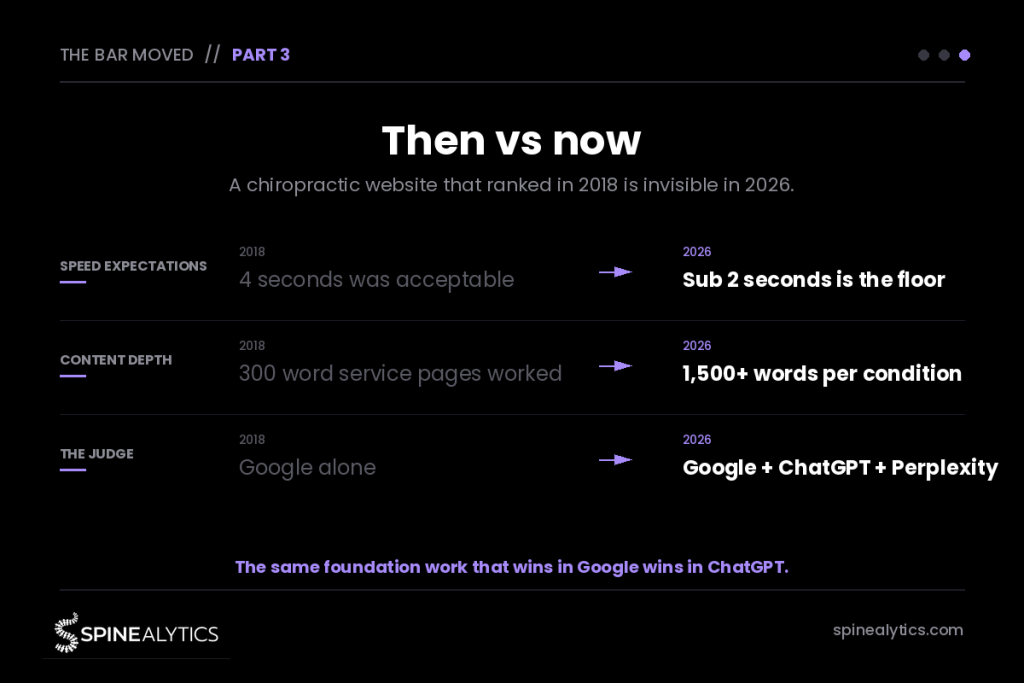
A chiropractic website that ranked in 2018 is invisible in 2026. The bar didn't drift up. It jumped on three things at the same time.
- Speed expectations cut in half. Sub two seconds is the floor, not the goal.
- Content depth requirements doubled. Thin pages get ignored by both Google and AI.
- A new judge entered the room. AI tools cite sources, and they're picky about which ones.
Here's the leverage point most chiropractors are missing:
The same foundation work that wins in Google wins in ChatGPT. That's leverage most chiropractors are leaving on the table.
One investment. Two channels. Compounding return.
The Five Elements
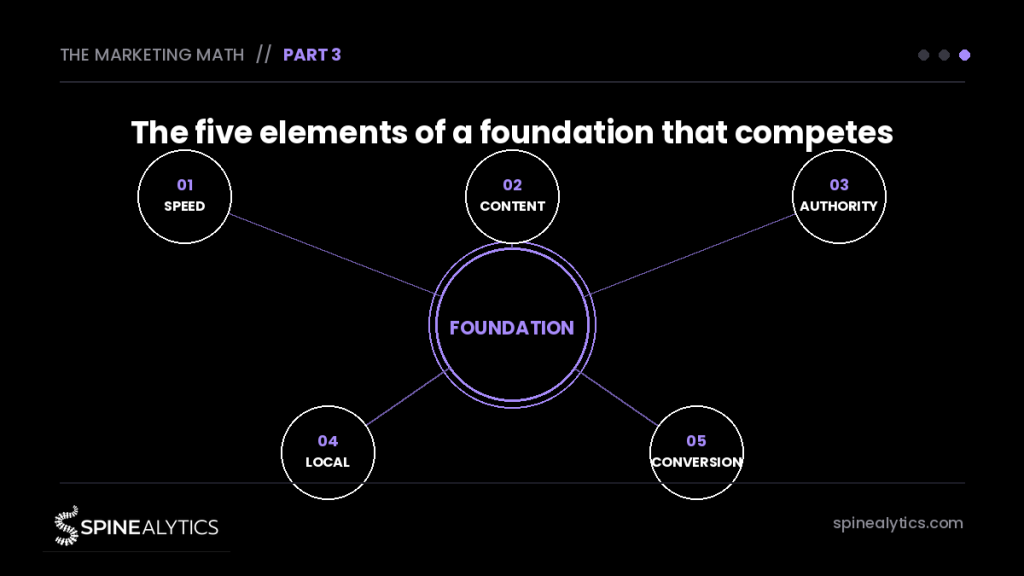
A foundation built to compete has five elements:
- Speed and mobile performance
- Content depth
- Authority signals
- Local signals
- Conversion architecture
Five elements. Every site we audit is missing at least three of them.
Element 1: Speed and Mobile Performance
Over 60% of healthcare searches happen on a phone. If your site loads slowly on mobile, you don't have a marketing problem. You have a visibility problem.
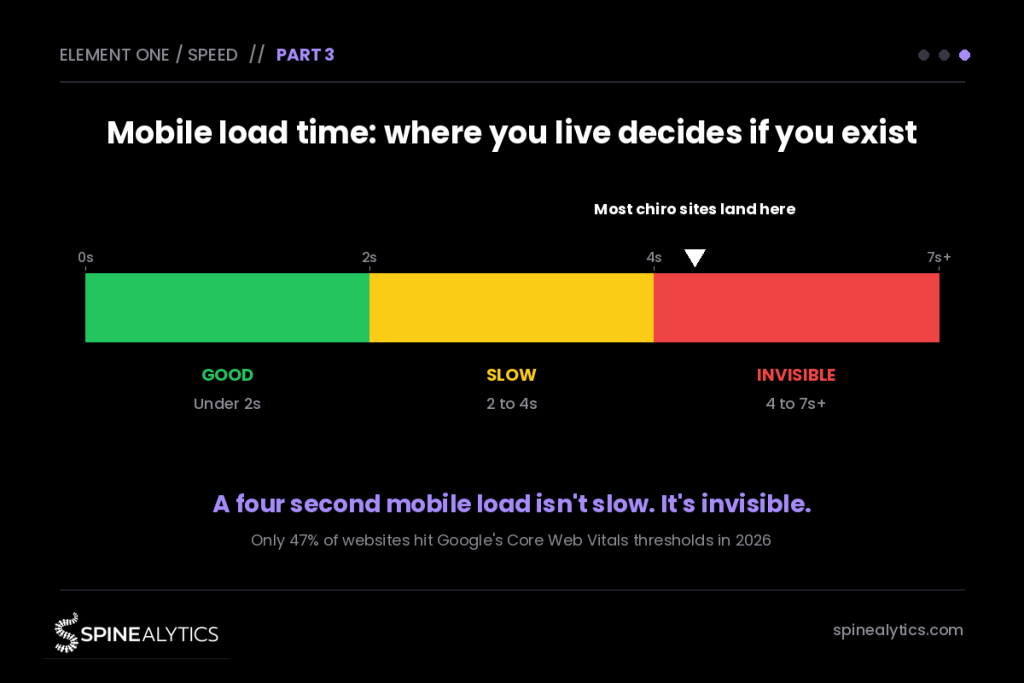
Google scores three Core Web Vitals: Largest Contentful Paint (LCP) under 2.5 seconds, Interaction to Next Paint (INP) under 200 milliseconds, Cumulative Layout Shift (CLS) under 0.1. In 2026, only about half of websites hit those thresholds. Most chiropractic sites we audit don't come close.
A four to seven second mobile load isn't slow. It's invisible. The patient bounces before your homepage finishes painting. Google's algorithm sees that and stops sending you traffic.
Speed is foundational because every other element on this list depends on the visitor staying on the page long enough to encounter it.
A four second mobile load isn't slow. It's invisible.

Element 2: Content Depth
"We treat back pain" is not a content strategy.
A foundation built to compete has a real page for every major condition you treat. Back pain. Sciatica. Neck pain. Disc issues. Headaches. Pregnancy care. Pediatric. Each page is 1,500 words or more, structured to answer the actual questions patients are typing and asking.
What causes it. What it feels like. How you diagnose it. What treatment looks like in your practice. Recovery timelines. When to seek care.
Two things happen when you do this work properly:
- Google indexes the page as the authoritative answer for that condition in your area.
- AI tools cite the page when someone asks ChatGPT or Perplexity for help with that condition.
Same work. Two channels. The leverage we talked about.
Thin pages get ignored. Deep pages get cited.
Element 3: Authority Signals
Google calls them E-E-A-T signals. Experience, expertise, authoritativeness, trustworthiness. AI tools look for the same things using different language.
The signals that count on a chiropractic website:
- Provider bios with real credentials, real photos, real history
- Real photography of the actual office and team, not stock images
- Reviews integrated with structured data so Google reads them as ranking signals
- Case studies and outcomes where patients allow it
- Clear, accurate contact and licensure information
A site full of stock photos and a single "About Us" paragraph signals one thing to Google and AI: this could be anyone. A site that shows real humans with real credentials in a real office signals trust.
In healthcare, trust is the ranking signal that matters most.
Stock photos are an authority leak. Every one of them tells Google you could be anyone.
Element 4: Local Signals
Local signals decide whether you exist in local search. Without them, the most technically perfect website is invisible to people three miles away.
The non-negotiables:
- NAP consistency. Name, address, phone number identical across every directory and listing.
- Schema markup. Structured data that tells Google what you are, where you are, and what you treat.
- Google Business Profile integration. Properly connected, regularly updated, with reviews flowing in.
- Service area pages. A real page for each city or neighborhood you serve, not a single "We Serve The Area" sentence on the homepage.
This is the unglamorous work. It's also the work that decides whether you appear in the local pack when someone three miles away searches "chiropractor near me."
NAP inconsistency is the silent killer of local rankings.
Element 5: Conversion Architecture
The foundation only matters if it converts what it attracts.
A working conversion architecture has three things:
- A clear, friction-free booking flow. New patients can book online without calling, without filling out a fifteen-field form, without creating an account.
- The right CTAs in the right places. Phone number above the fold. Book button visible without scrolling. Calls to action on every page that actually fit what the visitor is doing there.
- Trust signals near the conversion points. Reviews next to the book button. Provider photos near the form. Insurance logos where they reduce hesitation.
A beautiful site that doesn't convert is a brochure. A foundation that competes converts.
The foundation only matters if it converts what it attracts.
The Shortcut You Can't Take
Most chiropractic-specific website platforms (the ones that promise an easy build and a low monthly cost) are designed for the opposite of what we just described.
They use the same template across thousands of practices. The same content. The same structure. The same thin condition pages copied from a master library and lightly customized.
Google sees this. Google has seen it for years. Duplicate or near-duplicate content across hundreds of chiropractic websites gets one of those sites ranked, and it's almost never yours.
AI tools see it too. When a model decides which source to cite for a chiropractic question, it picks the page with depth, authority, and originality. It doesn't pick the templated page that appears verbatim on 800 other domains.
The shortcut sells you speed and simplicity. What it actually costs you is the work that wins. The platform is deciding what your practice can be.
Easy websites cost you the things that matter. The platform is deciding what your practice can be.
You're not on a website. You're on a leash.
The Four-question Foundation Audit
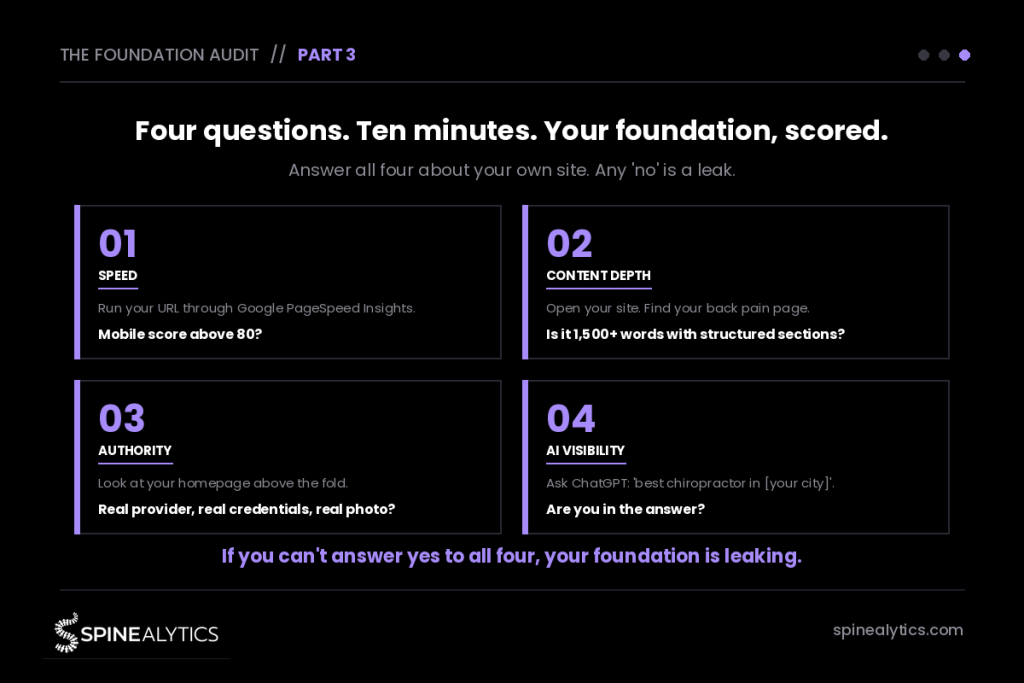
Four questions you can answer about your own site in the next ten minutes:
- Speed. Run your URL through Google PageSpeed Insights. Is your mobile score above 80?
- Content depth. Do you have a real, 1,500+ word page for each major condition you treat?
- Authority. Does your homepage clearly identify who is treating patients, with real credentials and real photos?
- AI visibility. Open ChatGPT. Ask "best chiropractor in [your city] for [a condition you treat]." Are you in the answer?
If you can't answer yes to all four, your foundation is leaking.
If you can't answer yes to all four, your foundation is leaking.
What's Next
A foundation that competes in SEO and AEO is the engine. But the engine still needs the right fuel.
The next post in this series covers the offer structure that builds retention from visit one, and why the $29 special is selecting against you, not for you.
A foundation either compounds or leaks. There is no third option.