What Actually Happens When ChatGPT Recommends a Chiropractor
AI Front Door · Part 2
Most chiropractors think AI search is a black box. It isn't.
It's a multi-step process with rules you can learn, exploit, and build for. The agencies still selling you 2018 SEO tactics either don't know how it works, or they don't want you to know, because their playbook stops working the moment you do.
Here's the mechanism, in plain English.
Training Data vs Real-Time Retrieval
There's a fundamental split most people miss. AI models know things two ways.
The first is training data. Everything the model "knows" was learned during training, then frozen at a cutoff date. This is what most chiropractors imagine when they think about ChatGPT. A static knowledge base.
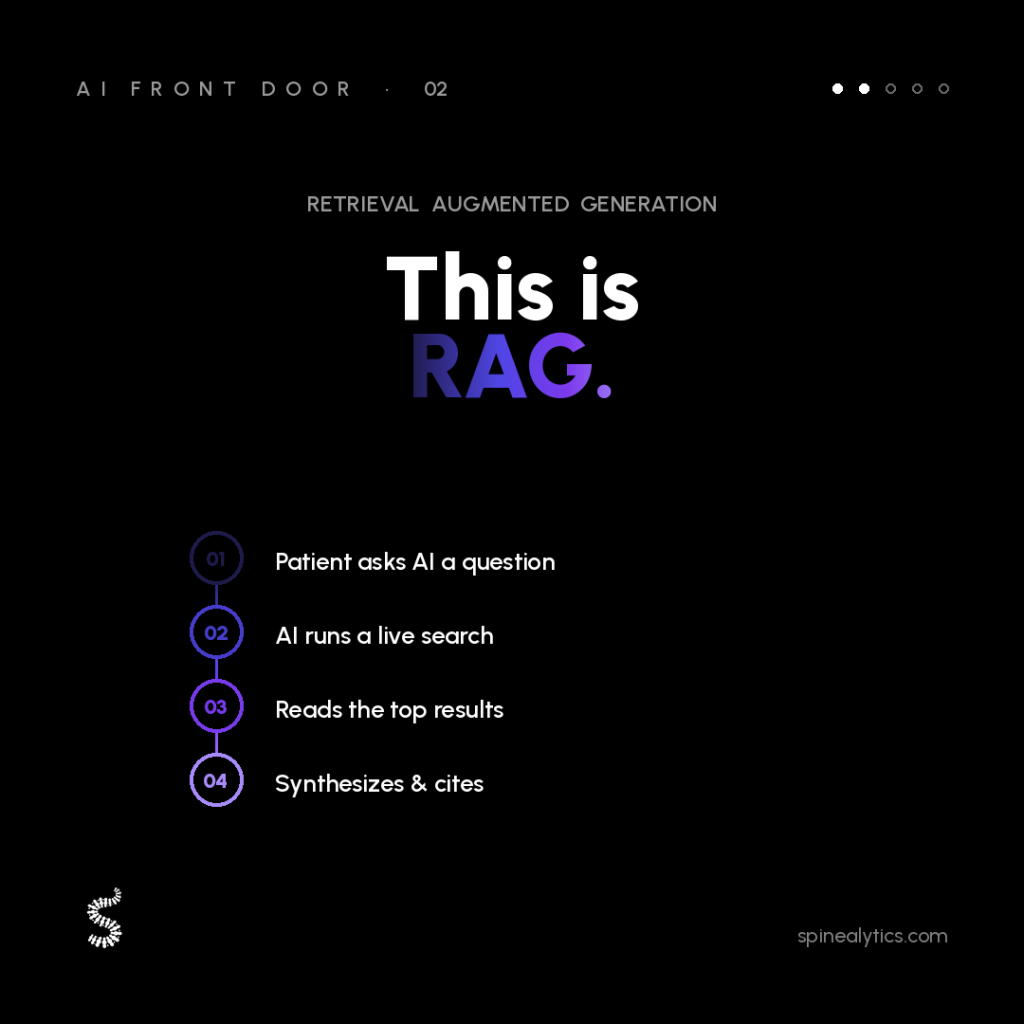
The second is real-time retrieval. When you ask ChatGPT a question about your local chiropractor, it doesn't sit there and try to remember. It runs a live search behind the scenes, reads the top results, and synthesizes an answer from what it just found.
This is called RAG. Retrieval Augmented Generation.
Almost every recommendation an AI gives you about a specific business, a current event, or a local service is happening through retrieval, not memory. ChatGPT does it. Perplexity does it. Google AI Overviews does it. Claude does it.
That distinction is everything.
It means the same discipline that put you in Google search results is what gets you into AI answers. But the rules are different. The page that ranks number one for "chiropractor Cleveland" is not automatically the page that gets cited in an AI answer about chiropractors in Cleveland.
How AI Picks Which Sources To Pull
When AI runs that retrieval search, it doesn't just grab the top ten links and call it a day. It evaluates sources on a different set of signals than classic SEO.
The factors that matter most:
- Topical authority. Does your domain consistently publish content on the subject the AI is researching, and do other authoritative sources reference you on that subject
- Content depth and specificity. Does the page actually answer the question, or does it hedge with generic copy that could be on any chiropractic site in any city
- Semantic match. Does your page address the concepts in the query, not just the keywords
- Recency signals. Is the content fresh enough to be trusted for a medical or local query
- Structured data. Have you used schema markup to tell the AI explicitly what this page is, who it serves, and what it covers
These aren't the 2018 ranking factors. The page stuffed with "best chiropractor in [city]" twenty-seven times doesn't win here. The page that demonstrates depth on a specific clinical topic, references credible sources, and has schema markup telling the AI exactly what it is, does.
Why Entity Recognition Matters More Than Keywords
Old SEO logic: rank for the keyword "chiropractor Miami."
AI search logic: get the AI to recognize your practice as a specific entity with specific attributes.
The difference is structural. Keywords are strings. Entities are things in the world that the AI builds an internal model of. Your practice is an entity. So is your city. So is each treatment you offer.
The AI builds those entities and their relationships by reading every mention of you across the web. The strength of an entity's association with an attribute depends on how consistently and how authoritatively that association shows up.
That looks like:
- Your practice name appearing consistently across listings, citations, articles, and reviews
- Your specialties associated with your name in multiple credible sources, not just on your own site
- Your geographic location reinforced everywhere
- Your name appearing in contexts where your specialties are discussed, even on sites you don't own
When the AI is asked "who treats sports injuries in Miami" it's not running a keyword search and ranking blue links. It's reaching into its entity graph and asking "which practitioner has the strongest association with both 'sports injuries' and 'Miami' across the sources I trust most?"
If you've never thought about your practice that way, you're not alone. Most chiropractic websites are built for a search world that ended two years ago.
The Citation Mechanism
When an AI cites you, three things happen at once.
It puts your name in the answer, sometimes with a link, sometimes without.

It pulls a snippet of your content into the synthesis, which means whatever words you used in that paragraph just shaped how the AI describes your practice to a future patient.
And it logs the engagement as a signal for future training cycles.
That last part is what compounds.
Citations beget citations. Once an AI model establishes a pattern, where it consistently associates your practice with a topic, that pattern reinforces itself in the next generation of the model. Users click your name. They read your snippet. They book. The signal feeds back into the system.
This is the practical version of the compounding citations idea from Part 1. Here's how it actually compounds. Not because some marketing executive said so, but because the architecture of AI search is built to reinforce winners.
The Three Layers You Need To Build For
Pull the mechanism together and you get a three-layer system every practice needs to think about.

Layer 1: Crawlable Depth
Pages the AI can actually read, parse, and cite. Real content, not template copy. Depth on the topics your patients are searching. Clear structure the model can pull from.
Layer 2: Entity Reinforcement
Your practice associated with the right topics, treatments, and location across the wider web. Mentions, citations, listings, articles, reviews. The more sources confirm "this practice does this thing in this place," the stronger your entity gets.
Layer 3: Structured Data
Schema markup that makes the implicit explicit. Tells the AI in machine-readable form what your page is, who runs the practice, where you are, what you treat, and how to reach you. Most chiropractic sites have none of this, or have the generic snippets a website builder added by default.
Most chiropractic websites don't have any of these in the right form. That's why they show up okay on Google and disappear completely in AI search. The two systems reward different things.
What Comes Next
Now you have the mechanism. You can stop guessing about why some practices show up in AI answers and others don't. The black box just became a stack of three layers you can audit and build for.
Part 3 covers what specifically stops working in this new model. The death of generic content. The end of "we serve the [neighborhood] community since [year]" template paragraphs that read the same on every chiropractic site in North America.
If your homepage could belong to any practice in any city, the AI treats it that way. As nothing.