

The Offer Structure That Builds Retention From Visit One
A perfect foundation can still bleed patients
Part 3 walked through what a chiropractic website built to win in SEO and AEO actually looks like. Speed. Content depth. Authority signals. Local signals. Conversion architecture.
But here's the part nobody warns you about. You can build a foundation that ranks. You can build conversion architecture that books. And you can still watch most of those new patients vanish after visit one or two.
The foundation gets them in the door. The offer decides who walks back in.
This post is about that second piece. Why retention is not something that happens at the table. It's something that's already decided before the patient ever shows up.
Retention is structural. It's built into the offer or it isn't built at all.
The offer is the filter, not the funnel
Most chiropractors think of their offer the way they think of an ad. Something to attract a patient. Something to get the booking. A funnel input.
That framing misses the most important thing the offer is actually doing.
The offer doesn't attract patients. It filters them.
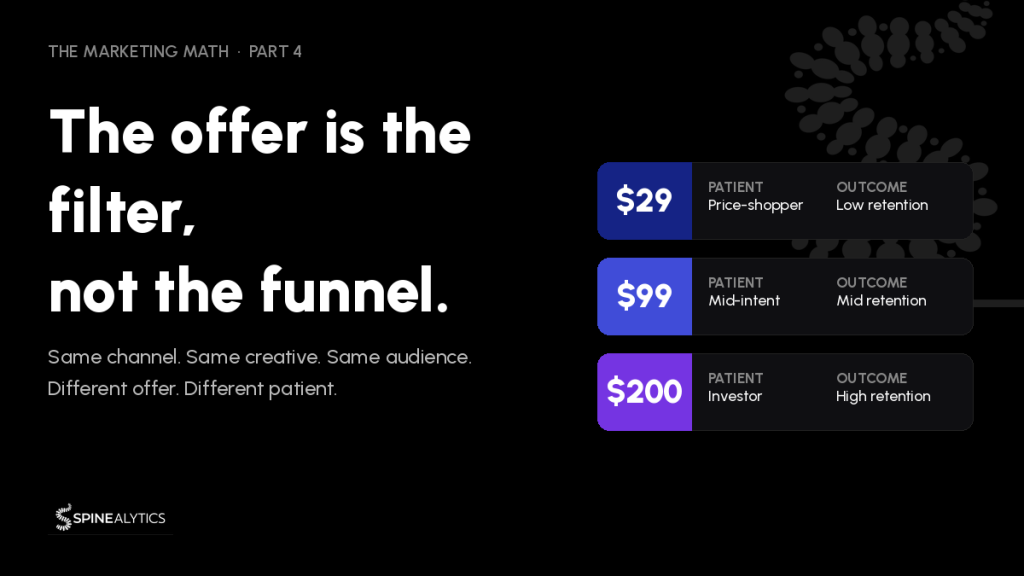
A $29 intro special and a $200 comprehensive consultation can run on the exact same channel, target the exact same demographic, and use the exact same creative. They will book completely different humans. Different intent. Different expectations. Different willingness to commit to care. Different lifetime value.
Same chair. Wildly different patient.
Your offer doesn't just attract patients. It selects them.
The selection happens before the click. The price, the framing, and the structure of what's being offered all signal who the offer is for. Patients self-sort. Price-shoppers click the deepest discount. People in real pain who want a real solution click the offer that sounds like a real solution.
If your retention is bad, the first place to look isn't the visit. It's the offer that selected the patient in the first place.
The four traps in typical chiropractic offers
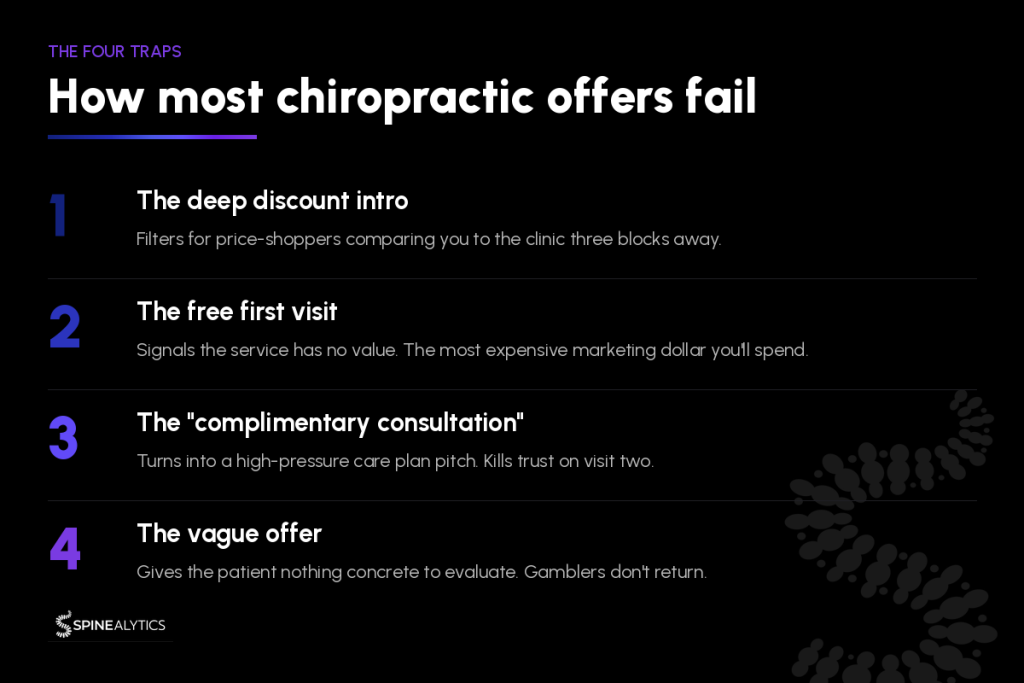
Most chiropractic offers fall into one of four patterns. Each one creates a specific retention problem that shows up later.
1. The deep discount intro. $29, $39, $49. These offers filter for price sensitivity. The patient who books a $29 special is comparing your offer to the clinic three blocks away running a $25 special. Whoever is cheapest this week wins. The discount trains the patient to think of your service as a commodity, then leaves you trying to convert them to full price care without ever proving the value gap.
2. The free or near-free first visit. $0 offers feel generous. They read as desperate. Free signals to the patient that the service has no value, which is the exact opposite of what you need them to believe before a care plan conversation. A free visit is the most expensive marketing dollar you'll ever spend.
3. The "complimentary consultation" that turns into a high-pressure care plan pitch. This is the trust killer. The patient walks in expecting a conversation and walks out feeling sold. Even if they sign the plan, the relationship is damaged. They show up for visit two skeptical of every recommendation that follows. Most don't show up at all.
4. The vague offer with no clear value. "First visit special." "New patient promo." The patient has no idea what they're buying, so they gamble. Gamblers don't return. They tell themselves they tried it once and it wasn't for them.
Cheap offers don't fail at retention. They succeed at attracting the wrong patient.
Each of these traps connects the visit-one experience to the patient who never comes back. Most practices never make the connection. They blame the patient, the market, the economy. The offer was doing exactly what it was designed to do.

What a retention-building offer actually does
A real offer does four things at once. None of them are about price.
It attracts a patient who values their health, not their savings. Pricing and framing pre-qualify intent. The patient who books at $150 or $200 has already decided they're investing, not gambling.
It sets clear expectations for what the first visit includes. No surprises. No bait and switch. The patient knows they're getting a consultation, a thorough exam, imaging if needed, and a clear care recommendation. They know what they're buying.
It demonstrates expertise before any commitment is asked for. The offer itself signals competence. A detailed intake, a comprehensive exam, a real diagnostic conversation. The patient experiences the practice's standards before they're asked to commit to a plan.
It creates a natural path to the next visit without high-pressure conversion. The recommendation flows from the exam findings. The patient feels educated, not pitched. The next visit is the obvious next step, not a sales objection to overcome.
When the offer does all four, retention stops being a fight. It becomes a consequence.
The math of retention
Numbers make this concrete.
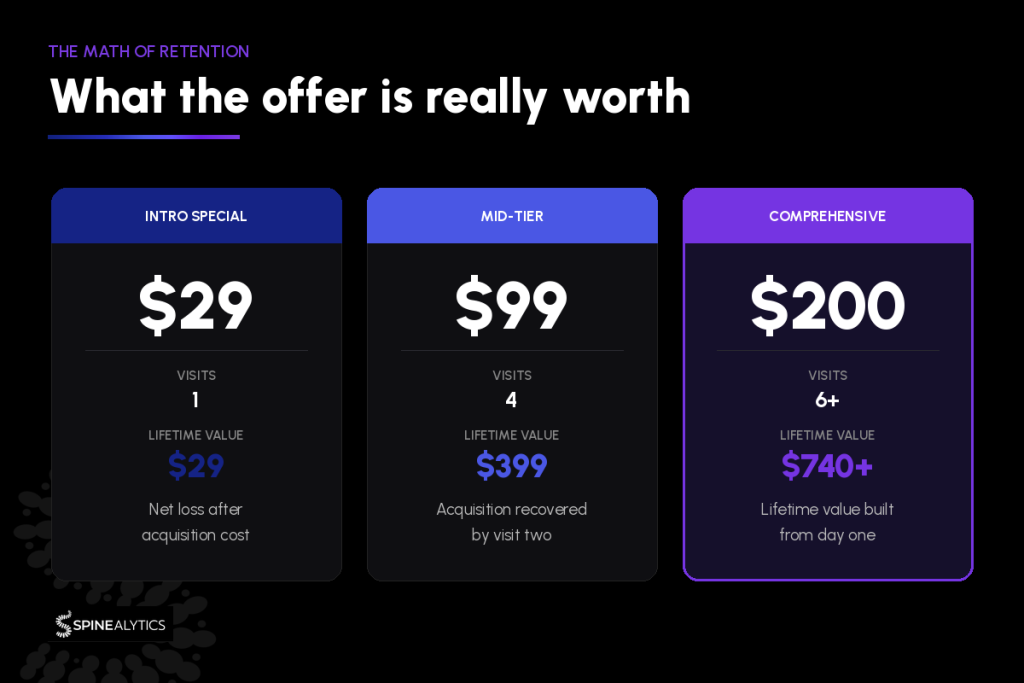
A $29 intro patient who comes once and never returns: the practice loses money on acquisition. Ad cost alone often exceeds the visit revenue. Net negative.
A $99 mid-tier offer with strong retention, returning for an average of four visits at $75 each: $399 in lifetime value from a single new patient. Acquisition cost recovered by visit two.
A $200 comprehensive consultation that converts to a six-visit care plan averaging $90 per visit: $740 in lifetime value. The patient also refers more often, because patients who paid full freight talk about results, not deals.
The point isn't that one price is right. The point is that price and structure determine which math you're actually playing.
Visit one isn't a chance to convert. It's the proof of what the offer promised.
Practices running $29 specials aren't building a patient base. They're funding an endless cycle of acquisition.
The offer doesn't end when the patient pays
This is the part most chiropractors miss.
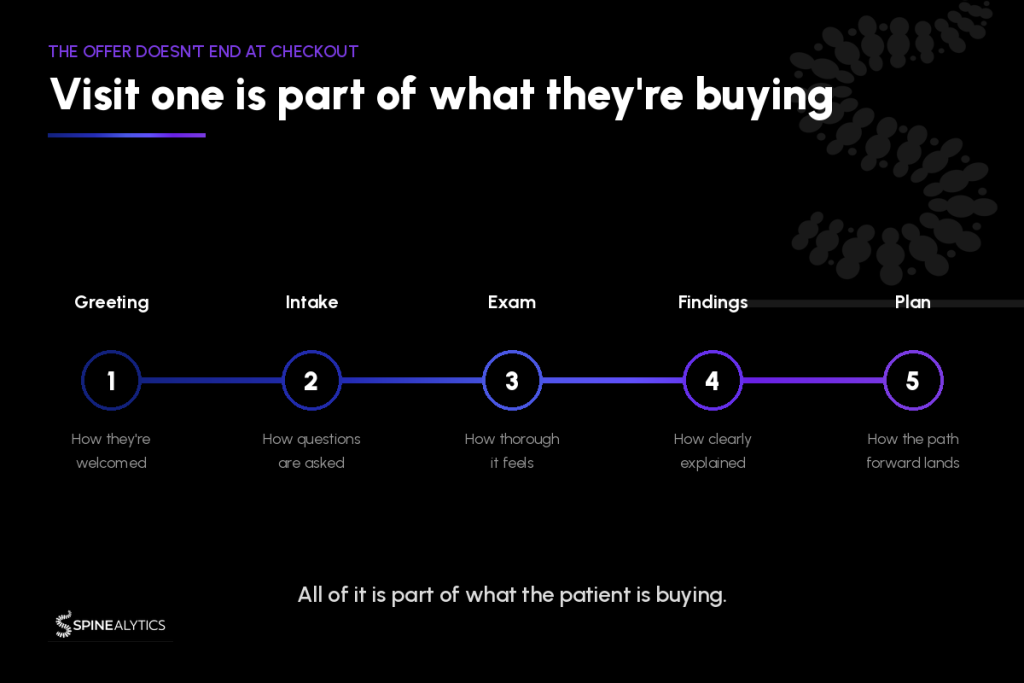
The offer doesn't end at the checkout. It continues through the entire first visit. The way the patient is greeted at the front desk. How the intake is handled. How the exam is conducted. How the findings are explained. How the recommendation is delivered.
All of it is part of what the patient is buying.
A great offer with a mediocre visit-one experience still loses retention. A strong offer paired with a visit that delivers on the promise builds a patient relationship that can last for years.
The offer and the experience have to match. That's a systems conversation, and it's where the next chapter of practice growth lives.
What's next in the series
One post left. The final piece pulls everything together.
- What to actually measure when you measure marketing ROI
Once retention is structural, ROI math becomes possible. Without it, every marketing number you track is fiction.
The patients are out there. The offer decides which ones stay.