

The Top Local SEO Mistakes Chiropractors Make (And the Fix for Each)
Local SEO is supposed to be the “steady engine” behind a chiropractic clinic’s marketing. It is the channel that captures high-intent searches like “chiropractor near me,” “sciatica chiropractor,” or “chiropractic clinic in [city]” and turns them into calls, direction requests, and booked appointments.
But most clinics that struggle with local SEO are not failing because they are missing a secret trick. They are leaking visibility (and trust) through a handful of fixable mistakes: incomplete Google Business Profile setup, messy location signals, weak review systems, and websites that do not reduce uncertainty quickly enough.
If you want more new patients without relying on seasonal spikes, local SEO basics matter because they compound. Small improvements to accuracy, consistency, and trust signals can raise your map visibility and increase conversions from the traffic you already earn. That theme connects closely with From Seasonal Spikes to Predictable Demand: Stop Relying on January and the broader strategy in Why Being Found Isn’t Enough in 2026: Build Your Content Ecosystem.
How Google Ranks Local Results for Chiropractors (Relevance, Distance, Prominence)
Before the mistakes, it helps to understand what you are actually optimizing for. Google has repeatedly described local ranking as a blend of relevance, distance, and prominence. (Google Help)
Relevance is how well your profile and website match what someone searched. Distance is proximity to the searcher’s location (or the location included in the query). Prominence is how established and trusted your clinic appears online, which is influenced by reviews, citations, links, and general brand presence.
Most “local SEO wins” are simply clinics improving relevance and prominence, while staying clean and accurate so distance can work in their favor when the search is nearby.

Local SEO Mistake 1: An Incomplete Google Business Profile
Many chiropractors claim their Google Business Profile (GBP) and stop there. They leave fields blank, skip services, do not add appointment URLs, do not upload recent photos, and never revisit the profile again. The result is a listing that looks unfinished to both Google and patients.
Fix: Treat GBP like a living profile, not a one-time setup.
Start by completing every field that is genuinely applicable. Add your hours, holiday exceptions, appointment link, services, and a tight description written for humans. Upload real, current photos of the clinic exterior, reception area, treatment rooms, and team. Then add a simple cadence: update photos monthly, post occasional updates, and monitor Q&A so incorrect answers do not sit there for months.
If you want to connect profile improvements to booked appointments, it also helps to align your site’s booking experience. A visitor might discover you on Maps, click to your website, and still bounce if the next step is unclear. That is where Website Conversion Basics for Chiropractors becomes a practical companion to local SEO work.
Local SEO Mistake 2: Inaccurate Address Details (Or Using a Non-Compliant Address)
Google’s address rules are stricter than most clinic owners realize. Profiles can get suspended or filtered if the address is incomplete, formatted incorrectly, or not a legitimate staffed location. Google’s guidance is clear about using a complete street address and including accurate suite/unit information. Google also warns against using P.O. boxes or remote mailboxes as a business address.
Fix: Make your address boringly accurate everywhere.
Use the exact same formatting on your GBP, website, and major directory listings. Include your suite number if you have one. Confirm that your signage and business presence match the address you publish. If you are a clinic that serves patients at a physical location, list the address. If you are truly a service-area business (rare for chiropractors), set it up correctly and avoid publishing an address you cannot legitimately staff.
When address details are correct, you remove an unnecessary risk factor and make it easier for Google to trust your “entity” across the web.
Local SEO Mistake 3: Keyword-Stuffing the Business Name
A common “shortcut” is adding extra keywords to the business name in GBP, like “Smith Chiropractic – Sciatica & Sports Injury Clinic.” It can create short-term visibility in some cases, but it is also one of the most frequent reasons profiles get edited by users, flagged by competitors, or restricted by policy enforcement.
Fix: Use your real-world business name, then build relevance elsewhere.
Keep your GBP name identical to your signage and legal branding. If you want to rank for specialties, you earn that relevance through categories, services, content, and reviews, not by stuffing your name field. In practice, clinics that focus on long-term prominence and consistency outperform clinics that gamble with policy gray areas.
If you want a structured way to build relevance without gimmicks, it helps to think in “ecosystem” terms—GBP supports discovery, but your website content and conversion path support decision-making. That strategy is outlined well in How to Get New Chiropractic Patients in 2026.
Local SEO Mistake 4: Choosing the Wrong Primary Category (Or Leaving Services Vague)
Category selection is one of the biggest relevance levers in local SEO. Many chiropractors choose overly broad categories, select the wrong primary category, or add irrelevant secondary categories that confuse the algorithm and the patient.
Fix: Pick the most accurate primary category, then support it with services and on-page content.
Choose the category that best reflects what you are, not what you also do. Then list services that are actually offered in the clinic, using plain language patients use. If your services include things like corrective care, posture-focused plans, or specific modalities, support those claims on your website with dedicated pages and clear explanations.
This is also where strong copywriting matters. A service list on GBP is not a replacement for a page that explains what a patient can expect. Your site should reduce uncertainty. If you have not built a high-clarity first-visit experience, review The Perfect New Patient Page for Chiropractors: What to Include to Reduce Anxiety and Boost Bookings, because that page often becomes the conversion bridge between GBP discovery and booking.
Local SEO Mistake 5: Treating Reviews Like a Nice-to-Have (Or Trying to “Game” Them)
Reviews are both a ranking input (prominence) and a conversion asset. Clinics often fail here in two ways: they do not build a consistent review request system, or they try to speed-run growth with incentives, gating, or selective asks.
Google’s published policy prohibits offering incentives in exchange for reviews and discourages practices like selectively soliciting only positive reviews. (Google Help) Even when clinics “get away with it,” it creates risk and undermines trust.
Fix: Build review velocity with a simple, repeatable system.
Use a win-moment approach: ask when the patient expresses gratitude or reports a meaningful change. Keep the request short and human. Use a single link to Google so there is no decision friction. The full workflow is laid out in How to Ask for Reviews Successfully Without Feeling Awkward.
Also, plan for the reality that negative reviews happen. Clinics that respond calmly and consistently protect conversion. If you ever need a step-by-step process, Reputation Damage Control: What to Do After a 1-Star Review is a solid playbook.
Local SEO Mistake 6: A Website That Does Not Confirm Location and Trust Fast Enough
Local SEO is not only about ranking. It is about what happens after the click.
A surprising number of chiropractic websites bury their location, make the phone number hard to tap on mobile, or lead with vague branding instead of clear “who we help and where we are.” Even if you rank well, the site can still fail the visitor in the first 5–10 seconds.
Fix: Improve above-the-fold clarity and the booking path.
Your homepage and key service pages should make three things instantly obvious: what you do, where you are, and how to book. Then reinforce trust with reviews, team credibility, and “what to expect” language that reduces anxiety. The conversion framework in Website Conversion Basics for Chiropractors is the cleanest way to align local visibility with actual outcomes.
If your site is outdated or slow, it quietly harms both conversion and local signals. This is where foundational pieces like Web Hosting for Chiropractors and Web Design & Development for Chiropractors matter from a user experience standpoint, not a “marketing buzzword” standpoint.
Local SEO Mistake 7: No Local Structured Data (And Inconsistent NAP)
Google needs consistent business information across your site and the broader web. That includes your name, address, and phone number (NAP), as well as clear “local business” signals that help search engines interpret your pages.
Google explicitly supports LocalBusiness structured data to help it understand business details like hours and other attributes. (Google for Developers) While structured data does not guarantee rankings, it reduces ambiguity and strengthens clarity.
Fix: Standardize NAP and add LocalBusiness schema properly.
Ensure your footer (and contact page) displays the exact same NAP as your GBP. Then add LocalBusiness schema that reflects your clinic accurately, including address, phone, and hours. Keep it consistent across pages and avoid conflicting details in headers, footers, and contact sections.
Local SEO Mistake 8: Thin or Duplicate Location and Service Pages
Many clinics try to rank for multiple nearby cities by creating near-identical “chiropractor in [city]” pages. These pages often add no unique value, which makes them weak for both SEO and patient trust.
Fix: Build fewer pages, but make them genuinely helpful.
If you serve multiple areas, write pages that reflect real differences: driving directions, neighborhood references, common local questions, and service intent. If you offer specialized care, write service pages that explain what it is, who it helps, what happens in a visit, and what results are realistic. This is where Copywriting for Chiropractors intersects with local SEO: good content increases relevance and improves conversion after the click.
Local SEO Mistake 9: Ignoring the “Prominence” Side of Local SEO
Prominence is earned through authority signals: consistent citations, quality local links, community involvement, and brand mentions that confirm you exist and matter in your area.
Fix: Build real-world credibility that also creates online signals.
Make sure your clinic is listed accurately on key directories and healthcare platforms. Earn local links through community partnerships, sponsorships, events, and collaborations that are legitimate and relevant. Publish content that answers local patient questions and demonstrates expertise without being salesy.
This is also where social content can support local SEO indirectly by increasing brand familiarity and engagement. If your clinic posts consistently, patients are more likely to recognize your name when they see you in the map pack. That broader support fits into the “ecosystem” approach outlined in Why Being Found Isn’t Enough in 2026: Build Your Content Ecosystem.
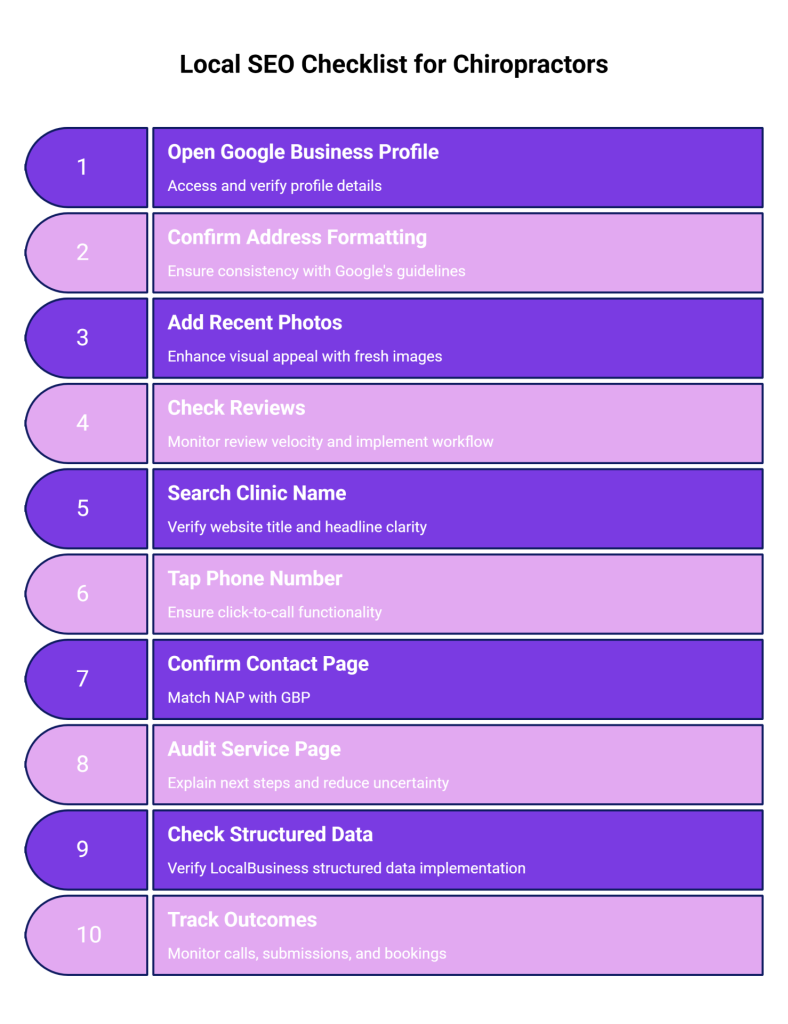
A 30-Minute Local SEO Checklist Chiropractors Can Run This Week
Open your Google Business Profile and confirm: categories are accurate, hours are correct, and services reflect what you actually offer.
Confirm your address formatting (including suite/unit) matches Google’s guidance and is consistent everywhere. (Google Help)
Add 10–20 recent, real photos if your listing looks stale.
Check your reviews from the last 60 days. If velocity is low, implement a simple request workflow (no incentives). (Google Help)
Search your clinic name and confirm your website title and homepage headline clearly state what you do and where you are.
Tap your phone number on mobile. If it is not click-to-call or hard to find, fix it.
Confirm your contact page displays the same NAP as GBP.
Audit your top service page: does it explain what happens next and reduce uncertainty?
Check if your site includes LocalBusiness structured data. (Google for Developers)
Track outcomes: calls, form submissions, and bookings—not just rankings.
If you want a broader “everything in one place” reference, The Ultimate Digital Marketing Checklist for Chiropractors is a useful structure because it keeps local SEO connected to conversion tracking, website quality, and patient acquisition systems.
Local SEO Is Not Separate From Modern Search and AI Visibility
Local SEO is still foundational, but it is increasingly connected to how clinics get summarized and recommended in AI-driven search experiences. That is why clarity, consistency, and trust signals matter more than ever. If you want the forward-looking framing, GEO: The Future of Marketing for Chiropractors is the best starting point, and it pairs naturally with a conversion-focused website foundation.
The clinics that win locally are not the ones chasing hacks. They are the ones that keep their Google profile accurate, their reputation strong, their website clear, and their local credibility easy for both people and search engines to verify.